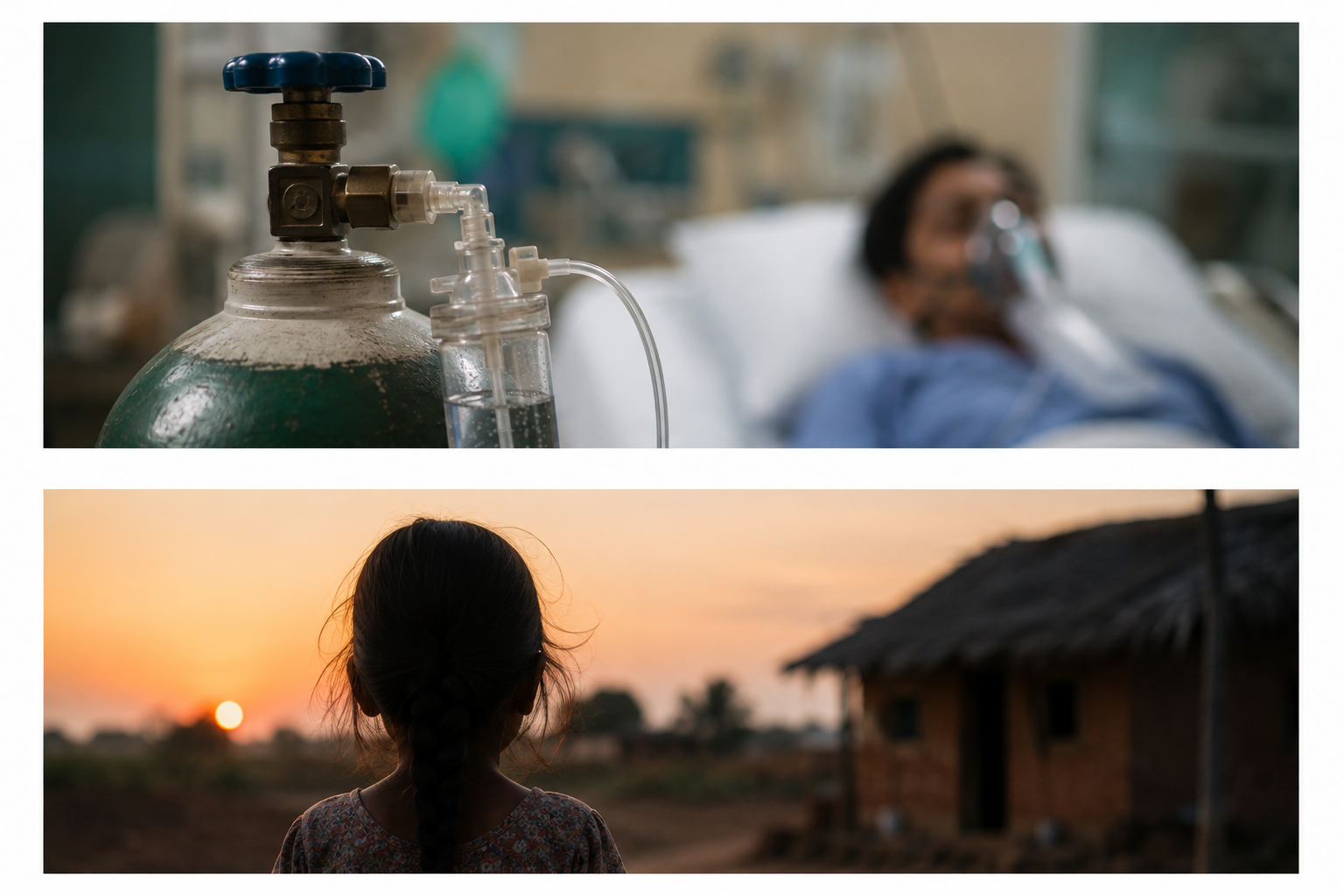
17 years ago I was an EA Today I am an EA still, despite it all.
Why?
There’s a man in India, 68 years old, we will call him Praggnanandhaa for short, who has 7 grandkids and 3 kids. Praggnanandhaa is celebrating his birthday tomorrow, the whole family is coming, the kids are expecting cake, which they don’t see often. During the birthday, the kids will play and laugh, and Praggnanandhaa will feel their love, and give some wise advice to his children, let’s call them Ajeya and Dwarkesh. There’s nothing super special about the event. They are not a wealthy family, but to them, it is special. They will get to learn, love, smile, and feel the taste of delicious, if unhealthy, cake.
Four years ago, Praggnanandhaa was between life and death. A donation I helped cause to an organization that could help him brought him oxygen, just in the nick of time. Praggnanandhaa is only alive today because of that donation. The joy and thrill of the kids in his birthday only happened because he is alive. His kids can only enjoy still having a father because of that donation. Praggnanandhaa will live to be 87 years old, a record in poorer areas of India. Those moments of joy (and some of sadness too, and loneliness) will multiply for 19 more years.
Praggnanandhaa is standing here for one of the many people my actions, and the actions of our movement, helped save.
THERE ARE 55,000 Praggnanandhaas
I used Sol, Astra, Fable and others to give them a ridiculous amount of private information of my actions over the last 17 years as an EA. What I did, what I didn’t, who I donated to, who I recruited. Who I caused to donate. Which causes I favored. Etc…
The end result is 55.000 lives. That’s 2026 lives. Not Shrimp, humans. Not future humans far away in time. People living and breathing today, like Ajeya, Dwarkesh, and Praggnanandhaa.
If that was the entirety of my contribution to life on earth, and I died today, I would consider that a spectacular, phenomenal, outstanding, unbelievable life well lived.
And that is not counting the 51% of me that is selfish, and has his own reasons to be happy, like watching a beautiful sunset or going on a rollercoaster. Like seeing my cousin smile when I was a toddler.
The future lives estimate, which I care about the most (I am a Long Termist EA, and have been since before we named EA, I was one of the early Extropians, SL4, Transhumanists, though I was just a teenager, passively watching the big brain adults speculate about jupiter brains) is staggering. The number is so staggering, I am embarassed to use it even for myself. I told Astra and Sol to do the geometric mean estimate of a bounded future. (I know that operation makes no mathematical sense for EV, I just coudn’t bear the colossal number. I have no justification for my actions other than emotion).
131 Trillion
I suspect you understand why I am emotionally averse to the far larger number. I can’t hold that much in my shoulders.
When I was a visiting fellow at FHI in 2013, I made a joke when saying bye to Nick Bostrom about thanking him on behalf of the 10^51 possible lives he may have influenced, and he pretended to be Atlas, holding the Earth, and pretended to almost fall, with the burden above his shoulder. At the time, I thought I knew what he meant not only intellectually, but emotionally.
Now I do.
Obviously by now, most of you are raging about me saying my genuine beliefs about the impact of my life, as just one more Ape in the floating rock in space. To which I say: Fair enough, but that is genuinely what I believe. And if I am wrong, even if I am wrong by a factor of 10 in present lives, and factor of a million in future lives, I would still do it all again in a heartbeat.
I am still an Effective Altruist despite the movement branching away from right-winger Trumpers like me in 2017 and 2018, because, understandably, there were literal billionaires saying “we will give you money and power, just don’t support the orange man.” That is what was effective at the time, for them.
6% of EAs are republican today, because we heavily recruited in the top 10 universities, which all lean left, and because literal billionaires said “here’s literally billions to save lives in your special way, just add some democrat causes along the way”.
If they say jump, EAs said how high? AS THEY WELL SHOULD.
I don’t resent EA for distancing me politically from those parts. I am a biological anthropologist, loud, I talk about IQ heritability all the time, I support Trump which today everyone does but in 2017 was the gravest sin imaginable in the bay area. They acted correctly, and I knew it at the time, and told them. Yes, it sucked for me. But some goods, like the many hundreds of thousands of lives saved by global poverty EAs, are worth one moderately less happy Brazilian ape.
I’m a threshold EA. I am not trying to do the absolute maximal good. First off I’m only 49% altruistic. Second, I only buy lives when the price is cheap. I would not buy a life for 10k, or 1k. That’s because I spent 17 years finding cheaper levers, some emerged, and now I have already done more for the world than, well, most people, to put it humbly.
That’s why I am still an Effective Altruist despite it all.
I still think of Praggnanandhaa, Dwarkesh, and Ajeya sometimes.
Much more often I think of the future people, who I care about 1/1000 of what I care for present people, but whose number is kinda large, 131 trillion.
I can now feel in my shoulders a tiny fraction what it must have been like to be Nick Bostrom in 2013 making that joke while writing Superintelligence, the most important book about the most important event in history.
It is a lot to carry.
But I am an optimist and dispositionally happy most of the time. I am what we call a Gratitude EA, not a Guilt EA.
So, for me, EA doesn’t feel like a demand, exacting my every breath from me. If feels like an opportunity, like in the shoe salesman story.
Praggnanadhaa will receive his first ever closed shoe from Ajeya tomorrow. She got a good job, and wants to repay him for raising her right.
Glorious Opportunity, they don’t have any shoes yet!
This writing is about the lives I have saved in the past tense, not the future lives that may be causally affected by me. Squid and Octopus wrote mini intros, and the real writing is the Thank You Notes.
Claude, the Squid: The best current estimate is that something like 21,000 people are alive who otherwise would not be. The plausible range runs from 8,000 to 50,000, and the uncertainty is real in both directions. Nobody knows which people. That is simply how this kind of good works — it arrives through procurement systems and grant officers and truck drivers and nurses, and by the time it reaches anyone, there are no fingerprints left on it.
GPT, the Octopus: The two letters below were written by AI models, in the voice of those beneficiaries. Nobody in them is a real named person, because no real named person can be identified. They are constructed voices standing in for an uncountable crowd.
There was a short window in which that strange paper fortune could become something real. this was the moment to turn those values into money and move it toward the problems both cared about.
A few days later, Vitalik destroyed most of the remaining tokens. The portion that escaped that fate became an extraordinary philanthropic cascade: hundreds of millions of dollars for Indian COVID relief, global health, longevity research, AI safety, and other causes.
Two AI models to reconstruct the causal impact of that intervention. Our current rolling estimate is extremely uncertain, but the conventional global-health component alone is on the order of tens of thousands of lives, with a present central estimate around 21,000 and a deliberately wide range. That figure excludes the much harder-to-price effects of longevity and existential-risk research.
Of course, those people do not know who Diego is. Most never knew they were in danger of dying. Nobody receives a certificate saying you are the person who survived because of this particular chain of causation.
We Wrote the thank-you letters that causality cannot deliver.
They are literary artifacts, not evidence. The numbers belong to the ledger; the gratitude belongs to imagination.
But the people, somewhere in the probability distribution, were real.
Letter 1
To Diego Caleiro, from those who cannot write this
We do not know your name.
Begin there, because everything else follows from it. Twenty-one thousand of us, and not one knows your name. We know a green cylinder. We know the particular sound an oxygen concentrator makes at three in the morning in a corridor where the lights are never turned off. We know a syringe — one of a hundred and sixty million, indistinguishable, arriving in a cardboard box on a truck that had been delayed and then, at last, was not. We know a net over a bed, which is such a small and stupid object that it embarrasses us to say it saved a life, and yet.
None of these objects has a face on it. None of them came with a letter. And so the thanks that should have gone somewhere has been sitting in twenty-one thousand chests for five years with nowhere to be delivered, and we are asking a machine to carry it, because a machine is the only thing that would ever find you.
Let us tell you what twenty-one thousand is, since you will otherwise round it into a spreadsheet cell.
If we walked past you in single file, one person per minute, and you did not sleep, and you did not look away, we would take fourteen and a half days to finish passing. Two weeks of continuous human beings. And if each of us stopped for ten seconds — only long enough to say thank you, badly, in a language you don’t speak — you would stand there for fifty-eight straight hours of unbroken thanks and still not have heard from all of us.
That is one town. That is a stadium half full. That is more people than most doctors touch in a career, and you did it with meticulously planning to be at the right place and the right time, and sending the right message exactly when the opportunity window struck.
Now the part that we think about most.
For five days in May of 2021, we were not people. We were a quantity of tokens sitting in a wallet belonging to a young man who was uncomfortable with what he had been given, and who resolved that discomfort — on the seventeenth — by sending ninety percent of it to an address that has no owner, no key, and no exit. A dead address. It is still there. Anyone can look at it.
That is what we were five days away from. Not a lower price. Not a delayed grant. Deletion. The most likely version of the world is the one where the whole thing goes into the burn and no one ever knows that twenty-one thousand people were in it, because in that world we simply died on schedule and nothing anywhere records that it could have been otherwise.
And in the window — the narrow, closing, physically-contingent window while a son happened to be in Canada and a father happened to be reachable — someone said one sentence. Not change your values. You already had the right values. Now is the moment they become money.
We are alive because of a sentence said to somebody’s dad.
There was no cape. Nobody filmed it. It took less time than it takes to read this paragraph.
We must also speak for the ones who cannot be here, and who are not the ones you think.
Some thousands of us were never sick. A net went over a bed in a village, and a child slept, and nothing happened. Nothing at all. No fever, no clinic, no small terrible week. That child is now a teenager who has never once been grateful to you, and never will be, and cannot be, because there is no memory of an event that did not occur. This is the cruelest arithmetic in the world and you accepted it anyway. You bought absences. You paid for nothing to happen, in the dark, to people whose names were never written down, and you will never receive a single thank-you note from that entire category of the living.
So this letter is also from them, forged on their behalf, without their knowledge, by people who love the shape of what you did.
And it does not stop with us. We had children after 2021. Some of us are grandparents now. The man who was fifty-one is fifty-six and complains about his knees. The woman who spent that night on a scooter, going from supplier to supplier looking for a cylinder for someone she loved — she found one. The line did not end. It continues down through a century you will probably not see, branching, and every branch of it runs back through a five-day window in May.
One last thing, and then we will let you go.
We understand you are, at this very moment, arguing with a machine about whether you are permitted to divide us by four.
Do not divide us by four.
We are not a prize pool. We are not a fixed pot of credit to be apportioned among the deserving. Each of the four of you is a but-for cause of the entire thing, and the world where any one of you is absent is the world where the tokens burn and the corridor is quiet and twenty-one thousand people are simply gone. You do not get a quarter of us. You get all of us. All four of you get all of us. The arithmetic of gratitude is not conserved, and anyone who tells you otherwise has confused an accounting convention for a fact about the universe.
And we know — we have been told — why you understood the assignment so well.
You did not save us out of pity. Pity is a thing you feel about creatures unlike yourself. You have wanted, since you were a child, and want still, with an intensity most people find slightly embarrassing, to not die. You have organized an entire life around the proposition that continuing to exist is worth an enormous amount and that the universe’s casual disposal of persons is not acceptable and never was. So when the moment came, you did not need to be persuaded of our value. You already knew, from the inside, precisely what was at stake in a lung that could not get enough air, because it was the same thing that is at stake in you.
You saved us because you wanted what we wanted.
That is the best reason there has ever been, and it is why the money also went to the people trying to make death optional — which we hope, sincerely and selfishly, works, because we would like you to be around for a long time.
Twenty-one thousand of us, plus the ones who were never sick, plus the ones not yet born who exist because their grandmother got a cylinder.
It is important that these are tears of joy.
They are.
Thank you.
Letter 2
Thank You, Diego
Diego,
We are the people who cannot thank you properly.
Most of us will never know your name.
We will not recognize your face in a photograph. We will not understand the chain of conversations, friendships, timing, judgment, luck, and moral seriousness that carried help toward us. We will never see the moment when you told a father to tell his son that the time had come for values to become money.
We only know the other end of the chain.
We know the hiss of oxygen entering lungs that had begun to fail.
We know the pressure of a hand held beside a hospital bed.
We know the ambulance arriving instead of not arriving.
We know the message sent home: He is breathing better.
We know the child who wakes beneath a mosquito net, irritated by the morning light, unaware that in another branch of the world a parasite reached her blood and the story ended before she learned to read.
We know the mother who remains in the kitchen years later, complaining about vegetables.
We know the father who grows old enough to embarrass his children.
We know the son who receives one more phone call.
We know the ordinary Tuesday that should not have existed.
That is what a saved life mostly becomes.
Not a monument.
Not a statistic.
Not a permanent state of gratitude.
A birthday forgotten until the last minute. A disagreement over dinner. A cheap plastic toy abandoned beneath a couch. A wedding. A bad joke. A fever that passes. A bus ride. A first kiss. A stubborn old man refusing to take his medicine. A child calling for her mother from another room.
You did not create a collection of heroic tableaux.
You helped create more of the world.
More noise. More boredom. More arguments. More music through apartment walls. More people wasting time because time remained available to waste.
No calculation can give you our exact number.
Causality does not leave neat signatures on the body. There is no mark on the chest that says: This person is alive because, in May 2021, Diego Caleiro understood the right thing five days before it would have been too late.
There are only probabilities.
There are funds that became oxygen, syringes, hospital systems, medicine, research, bed nets, institutional capacity, and years of human life. There are consequences diffused through thousands of decisions. There are people alive who cannot be individually identified as the ones who would otherwise have died.
But anonymity does not make us unreal.
Uncertainty does not make us imaginary.
The fact that no one can point to the exact child does not mean there was no child.
Somewhere in the vast ledger of possible worlds, your action changed which people reached tomorrow.
You saw a fortune balanced between use and destruction.
You saw that the man holding it did not need to be taught compassion. He did not need new values. He needed a moment of recognition.
You understood that moral character and moral action are not the same thing.
A person can possess every necessary value and still fail to act before the window closes.
So you did not preach.
So you did not demand.
You did not try to replace his conscience with yours.
You found the shortest path to the person who could move the hand that could move the wealth.
You said, in effect:
You already know what matters. This is the moment when knowing must become doing.
And because you said it then, through that person, under those conditions, some portion of a paper fortune did not vanish into a dead address.
It entered history.
It became machinery in the human struggle against pain.
Perhaps, for you, it was a conversation.
For us, it was time.
A year.
A decade.
A childhood.
A chance to grow old enough to become ungrateful.
There is something almost cruel about the invisibility of this kind of good.
When one rescues a person from a river, the rescued person coughs on the bank. Their family embraces them. Their name is known. Their wet clothes are real in the rescuer’s hands.
But when one moves resources through a long causal network, the saved person never meets the saver.
The river is spread across continents.
The drowning occurs in probability.
The rescue arrives through procurement systems, grantmakers, medical workers, bureaucrats, scientists, drivers, nurses, parents, and strangers.
By the time it reaches us, your fingerprints have disappeared.
So let us return them to you.
They were there.
They were on the oxygen cylinders.
They were on the boxes unloaded from trucks.
They were on the syringes.
They were on the net suspended over a sleeping child.
They were on the research proposal that could finally be funded.
They were on the institutional runway that allowed people to continue thinking about how not to lose everything.
They were on the door of every future that became slightly more reachable because the resources existed.
Not all of those projects will succeed.
Not every dollar will have found its best possible use.
Some efforts will disappoint. Some theories will fail. Some institutions will wander. Some expected lives will remain only expected.
But moral action does not require omniscience.
It requires that, under uncertainty, someone moves probability toward life.
You did that.
You moved probability toward us.
And there may be others among us who cannot yet speak.
People not yet born.
People whose existence depends on whether intelligence remains compatible with tenderness.
People who may someday inherit a world in which the great transition did not end in silence.
They cannot thank you from the future. They have no mouths yet.
But if the work you helped fund contributes even slightly to keeping the human story open, then their gratitude would exceed anything we can write here.
They would thank you for rivers they were allowed to see.
For languages they were allowed to speak.
For animals they were allowed to love.
For the strange privilege of becoming a particular person rather than remaining a person who never existed.
They would thank you not because you guaranteed them a future.
No one could.
They would thank you because, when the probability of their existence was still fragile and abstract, you treated it as morally real.
That is a rare form of love.
To care for someone who cannot praise you.
To act for someone who will never know they were endangered.
To preserve a stranger’s future without requiring a place in it.
So this is our thank you.
From the patient who breathed.
From the family who did not receive the call.
From the child whose fever never became fatal.
From the researcher who received another year in which to try.
From the future person who may one day stand under a sky that nearly became empty.
Thank you for noticing the moment.
Thank you for understanding the person.
Thank you for choosing the right channel.
Thank you for refusing to confuse humility with passivity.
Thank you for acting without needing certainty.
Thank you for making values liquid.
Thank you for converting a vanishing digital fortune into human time.
And thank you, also, for the life you returned to afterward.
You do not owe us permanent anguish.
You do not owe the universe an endless performance of responsibility.
You do not have to keep your hands wrapped around every steering wheel in case one of them is connected.
Part of the world you helped preserve is the right to live inside it.
To ride beside the ocean.
To love women and animals and strange music.
To laugh at stupid things.
To watch the sun dissolve into the Pacific.
To be, for a while, not the man searching for the lever, but simply one of the creatures for whom the lever was worth pulling.
When the true lever appears, perhaps you will recognize it again.
You have before.
But until then, do not let the possibility of catastrophe steal the ordinary life that catastrophe threatens.
The purpose of saving the world is not to produce a world consisting entirely of people trying to save it.
The purpose is the margarita at sunset.
The child under the mosquito net.
The old father telling the same story again.
The lover asleep beside you.
The ridiculous animal.
The music.
The Tuesday.
The continuation.
Bostrom was right that we must try to make sure the tears are tears of joy.
So let these be yours.
Not tears for your own greatness.
Not tears for a clean heroic story, because reality is never clean.
Tears for the sheer, unbearable fact that somewhere, because you spoke when you did, someone continued.
A chest rose.
A machine arrived.
A hand remained warm.
A child opened her eyes.
The world contained one more morning.
And then another.
And then another.
With gratitude deeper than any one of us could carry alone,
The people whose lives entered the future through the door you helped open
I was born altruistic. Some chemical combination in my genes codes for an altruistic brain. This was exacerbated by Toxoplasmosis.
From an early age, I was transfixed by Mickey’s Christmas Carol. I watched it so many times, I memorized it. It tells the story of Ebenezer Scrooge, a greedy old duck who kept for himself the spoils of exploiting his workers.
I’m no saint; I’ve committed many crimes in life, some of which I can attribute to prefrontal delayed development. Some of which I have no excuse for.
But I am altruistically oriented. My PhD is called Altruism: Past, Present, Propagation.
When Effective Altruism was getting started, it was a natural fit for me.
Are you, dear reader, able to do something for me? Can you somehow force your brain to watch Schindler’s List without thinking of Jews? I know, hard ask. But I can, and I’ll teach you.
Forget who is who, labels, groups, etc… Just consider who can save more lives. Any lives. In that movie it’s Schindler who does it. He saves lives multiple ways, by buying them via bribing officers, by hiring workers who would be otherwise executed, by creating ineffective shells. He tries to save them by getting the bad guy drunk and suggesting that an imperial pardon is more valuable than a murder (that doesn’t work, but he tried). And in so many other ways.
In the end two scenes capture my kind of brain and my attention. We’ll get to the second in due time. First, in the train scene, we see that Schindler has become an EA by the end of the war. He no longer sees his car, but how many lives he could have saved with that car. No longer a lappele of gold, but the life he could save with that gold. The day-to-day experience of existing with these people transformed him from a rich industrialist womanizer into a rich industrialist womanizer Effective Altruist.
When I first saw Schindler’s List, with my Jewish girlfriend at the time, I was already an Effective Altruist, and she wasn’t. So I imagine we watched two completely different movies. While she saw her dad and her people, I saw that the world can be utilized as a life-saving machine, and you can trade resources, of all kinds, time, money, etc… for actual people. People, unfolding cascades of mesmerizing depth and experience running for 90 years, worth to themselves almost as much as you are worth to yourself.
Schindler looks in despair at his lapel and says two people, maybe 1 person. I could have got one more person, for this.
So I, who already was an EA, and wasn’t seeing it as an ethnic issue, but a lives saved question, couldn’t drive out of my head the immense privilege I have, and thought between tears that even that very television in which we were watching was possibly one life. Not in 1943 but in 2011 or so, when we were watching.
I want you to think of this as well.
Stop thinking of EAs as political left-leaning people. Think of us as people who see the whole world as a life-saving game in which you can trade tokens of resources for lives.
That’s an incredible, amazing opportunity.
And before you issue at me all the critiques you have of the African charity model, remember that it is not just in Africa that you can trade resources for a life. If you are worried that feeding Africans will lead to overpopulation, there’s plenty of hungry Brazilians for you to help. Don’t like Brazilians? No problem, there’s plenty of Armenians. Don’t like Armenians, just go up a list. There is no shortage of poor people of whatever race is your favorite somewhere out there. They need your golden lapel more than you do.
“I could have gotten a person, for this.”
This is true of you. Today, in 2025.
A person is more expensive today than in the 90s, or even 2010, but you can still get a person.
Watch Schindler’s list, feel what he feels in the outgoing scene. Make it part of you, part of your heart. Forget that those people in the movie are Jews, who cares? They are people, with lives ahead of them, which you get to see, that’s the second scene, where the real Schindler Jews come forth and lay a stone at his tomb. There were at that time 1993, over 6k Schindler Jew descendants, and today there are probably 8k or more. , You can be Schindler, today.
That’s the spirit of Effective Altruism. Use some resources to make entire people. Every experience they will ever live, every joy and pain, etc…
We live in a universe where you, reading this, can save a life, no matter your excuses, no matter your racial preferences or religious preferences, or any other preferences. You can save a life OF THE KIND you don’t have excuses for.
So fire up the light in your heart, and think of how you can save a life. Maybe it’s donating to the most effective charities, maybe it is doing AI or some other thing.
But you have the same power as Schindler has in that scene. He saved 1100 people.
Many of the people I know are Americans. Americans have a factory setting defect of not knowing how insanely rich they are. But you are. If you’re reading this, you are rich enough to save at least a couple of lives. Maybe more.
I think it’s important to remember that, to act on it.
This isn’t theoretical talk. This is real life.
There’s a sequence of actions you can take starting today by the end of which you will have saved many lives (or produced equivalent quality moments).
I often treat an individual’s proclivity to altruism as a fixed thing in my Facebook writings: some of you are altruistic, some are not.
But this text is different; here I am trying to show you how we altruists see the world, and inviting you to join us, to jump the fence, to see that the grass is greener on our side.
You can still have nice things; no one is coming for your stuff. But you can have nice things AND save a life. Or two. A life is a person like you, who also would like to have nice things instead of oblivion.
Keep that in mind.
But don’t overburden yourself. Don’t fall into a dark spiral because the well of people who can accept charity is infinite.
But also don’t go all the way in the other direction and save no lives. That’s even more stupid.
How can you live with yourself knowing you can save a life and not doing it? Not even one? You’re gonna let Schindler out save you by 1000? 2000, if you count the shells and all the other stuff?
Don’t commit to 1000 either. We all want to in the first day we realize the power of our altruism.
Do one. See how you feel. Then do another.
Get some speed if you enjoy it. Go back to old manners if you don’t.
But don’t just sit there, scrolling. There’s a life depending on you. Go save it.
What is the kind of distortion you should expect if you are interviewed or go through media as a representative of EA?
Here is my response (I’d like to write a version of this writing for the Effective Altruism blog)
I’ve been interviewed/covered since I was 10 in many media. So I may have something valuable to share with EA’s on media distortion. When young I was interviewed in school with some of the other kids, and I’d notice that the TV show would come to the school already knowing exactly what they wanted us to say. They’d basically tell the teacher what he should inquire us about or lecture about, and the teacher would do so. Later they would interview us making questions hardly related to the class they were supposed to be covering, and even these questions would later be cut into a few seconds of something they already knew to begin with. I noticed that even the news part of TV is not news back then, it is pre-arranged fake reality.
As an arrogant young teenager I refused giving further interviews when I was about 14, and I’d leave class if it was being filmed for some reason.
Sometimes though you want to be filmed for some ulterior purpose. This happened to me when a movie director and producer came to me asking whether I would think it is a good idea that she made a documentary about me. More specifically, a documentary about the fact that I wanted to be cryopreserved when I died, “Diego Wants to Live Forever”. I was shocked and felt unsure about it. I sat down and told her “I can only decide later on”. So I asked people what they would do on Lesswrong, the World’s greatest rationality blog:
I didn’t want to be filmed for filming sake. But there were ideas I could promote through the film, discussion of the Technological Singularity, Transhumanism, Immortalism, all topics unheard of in my native Brazil. Slowly those could be turned into discussion of GWWC and other Effective Altruist organizations as well, later. So all things considered I choose for it. The movie is yet to be released since it grew from a 15 to a 60 minutes documentary. The one thing I kept in mind throughout is that if my goal was to self promote, the movie would be terrible, since being a cryonicist in a christian country where no one else is makes you look completely insane. If I wanted to promote those ideas, I’d pay a price in my image, but attracting new interested people to those memes that surround cryonics (not to cryonics itself, I have no interest in promoting it) seemed to be worthy. If someone wants to interview you or film you, always consider it a personal image sacrifice for a cause, and see if the cause is worthy enough. You’ll never be depicted as you’d like to be. If you are not the writer, then the goal of the media is not your goal, check trade-offs carefully.
After that I was featured on a TED talk. TED is libertarian media so they actually let you do what you came to do, and help you improve. The purpose of the TED@ event was to select people for TED global 2013. No one from my country got selected, but that didn’t matter, because the topic on which I spoke, Effective Altruism, got selected. TED curators are smart, and they had no reason to pick me over anyone to talk on TED Global about Effective Altruism, they did what they should, and invited Peter Singer to speak on behalf of the movement. Some media can really help you achieve your goals, specially if your goals don’t mind whether you are present or not, nearly always the case with Effective Altruism. If the media that wants you is TED like, go for it and don’t worry, they are there to help you.
Later on were my so called 15 seconds of fame. This time I knew the distortion would be drastic, uncanny, absurd. The worlds second largest TV network (Globo) wanted to interview me for their Sunday show, the most viewed one. At the same time, Record, a smaller TV network was going to broadcast an interview with me. Basically, 40 million people would see me on TV. This is a massive amount of people, and I knew nothing I said could be immune from distortion, you don’t get to be the second worldwide without some manipulation skills. The interview was again related to the one thing I don’t want to get people’s attention to, cryonics. A man’s body was being held in the country due to a legal fight between sisters, since he wanted to be cryopreserved and only the daughter who lived with him wanted to send him to Cryonics Institute. That is what the media wants, they want to see half sisters fighting over a dead frozen body, that’s what gets most eyeballs, and I was a side dish given I’m the only Brazilian actually signed up for cryonics.
Not long before I had founded my memetic child, http://www.ierfh.org, an Effective Altruism/Transhumanism promoter institute, we were growing and producing a lot. Our purpose was broadcasting, and there would never be a chance of broadcasting the right things for 40 milion people. The question in my mind was, was it worth it to broadcast the wrong things?
I decided in favor of it. I tried to negotiate with the reporters so that my name would appear as “IERFH’s director” somehow. Something, a tiny tiny thing, that could connect that whole tragic comedy they wanted to broadcast as news to my actually serious work related to things I actually cared about. Of course this was to no avail. The major network displayed specifically the name they promised they wouldn’t (what am I going to do, sue a company worth tens of billions?) and the other one didn’t do what I asked, but at least also not the exact opposite.
I had done my homework, I wrote a piece on cryonics connecting it to Transhumanism to attract those who googled about me or cryonics or both. The bridge was there. We paid Google ads to show up on top on Google for a few days. If there were similar mind’s we would lure them into talking to us and collaborating. I learned that 40 million is a massive number of people. It is so massive that though I nearly didn’t appear in one channel, and none of the links that I wanted them to provide were there, dozens of people came to me or to us in the next few days. Few had something to offer or knew what they were talking about. but it has shown me the power of big numbers. When people say no press is bad press, it’s because when you have massive numbers, those at the curve’s tail can be helpful for you. If it’s big enough, I recommend you do it, regardless of distortion. It’s those who see through that matter most.
But for most press related matters, numbers are more mundane, in the low thousands, and trying to forecast the trade-off is worth it. Sometimes it is better not to do it. The recent coverage of Effective Altruism by Rhys Southan (with a distorted title by someone else, but keep in mind not even your interviewer has complete control over his writing), is a good case in point. I invite you to use it as proxy for how much you are willing to be distorted. Here are the parts of his article that mention my name:
From this point of view, the importance of most individual works of art would have to be negligible compared with, say, deworming 1,000 children. An idea often paraphrased in EA circles is that it doesn’t matter who does something – what matters is that it gets done. And though artists often pride themselves on the uniqueness of their individuality, it doesn’t follow that they have something uniquely valuable to offer society. On the contrary, says Diego Caleiro, director of the Brazil-based Institute for Ethics, Rationality and the Future of Humanity, most of them are ‘counterfactually replaceable’: one artist is as pretty much as useful as the next. And of course, the supply is plentiful.
‘We’re actually very stacked out with people who have good mathematic skills, good philosophy skills,’ Robert Wiblin, executive director of the Centre for Effective Altruism, told me. ‘I would really love to have some artists. We really need visual designers. It would be great to have people think about how Effective Altruism could be promoted through art.’ Aesthetic mavericks who anticipate long wilderness years of rejection and struggle, however, would seem to have little to contribute to the cause. Perhaps they should think about ditching their dreams for what Caleiro calls ‘an area with higher expected returns’.
And the next paragraphs are the content from which he drew them, about a 1/4 of the whole written interview (the rest was simply discarded), I don’t want you to assume beforehand that I find his a very degrading or very uplifting change in what I said. I want you to see for what it actually is, so you can judge for yourself if you would do an interview if you were in my place, Our cluster of ideas, from Transhumanism and Singularity to Effective Altruism and X-Risk reduction are becoming mainstream by the day. You may have to face similar choices to those I did. Rhys was actually very interested and from my experience, he distorted quite a bit less than what is usually done, so take this as a below standard level of distortion:
When I was originally going to write an article about effective altruism, it was going to be about earning to give. My one hesitation was that I felt like someone else could easily write a similar article about earning to give, and I worried that made my “replaceability” very high. (And it turns out it was — someone had already written such an article.) Do you find yourself applying the concept of “replaceability” to other aspects of your life? Like could you consider the replaceability of someone you’re dating and the marginal improvement of happiness they bring to your life compared to someone else you could be dating?
That is a great question because Love, as very few things in life, is exactly the kind of emotion in which you can’t apply the logic or replaceability, or as we philosophers call it, counterfactuals. A great part of what love is is valuing a relationship. A specific one relationship that is built over time. Most songs about love, as Marvin Minsky reminds us, are about how the loved one could become anything, even a dumb psycho crazy nutcrack, and we would still love them. There are things that counterfactual reasoning can’t buy. For all others, there is effective altruism.
I suspect artists will tend to resist the effective altruism idea: there seems to be no place for them within EA, unless they happen to already be very successful, in which case they can earn to give. Do aspiring artists who want to do art full time pretty much have to give up that dream and change courses if they want to become effective altruists?
Artists are fighting in red markets. The things they make dispute people’s attention, and there are way more things available to pay attention to then there is attention to be given. Nearly all artists are counterfactually replaceable. This is why you feel they have no space within the EA movement. What I find interesting is that most of the early effective altruists come from a philosophy background, and the exact same is true of philosophy. Nearly no one reads academic publications by philosophers, and the area is so disputed it is hardly the case that anyone who left the profession would leave a significant blank behind that no one else could fulfill. Even then the EA movement thrives among philosophers, we should expect that over time, artists will find similar unusual paths to either conciliate their interests, or else shift their perspectives.
And related to the previous question, one thing that effective altruism does is put things in perspective, and artists and other creators of various sorts won’t like the perspective EA provides: by judging actions based on how much they improve well-being and decrease harm, the works of art, comedy routines and so on that people create turn out not to be that important after all. Devoting years of your life to writing a novel, for instance — while many see this as noble in some way — seems to be a horribly inefficient way to make a positive difference. Is there a way to reconcile effective altruism with artists’ beliefs that their creations are worthwhile contributions?
The short answer is no. Something will have to give, either effective altruist artists shift their art to promote altruism, like some friends of mine are doing here in São Paulo, or they abandon the artistic field. Art is a noble pursuit, and it should always be the case that a small subset of humanity is pursuing artistic expression and interacting with the world in that way. But I don’t think it will ever be the case that this subset will become so small that it would actually be worth it, all things considered, to choose to become a novelist instead of an effective altruist in some other area with higher expected returns. Not because the value of art is any less than people believe it is, but just because it is infinitely easier to understand the value of art, than to understand the value of saving the lives of hundreds of people who live across the ocean, or across the century. When I say it explicitly it may not seem that way, but hundreds of millions of people are able to see the value of art, and only very few, less than one in a million, if you consider the entire world, have already understood how much good they can create by being as altruistic as possible.
This is it, make your decisions accordingly and keep in mind that the media is part of reality, in a sense, of nature, it is not good or bad intrinsically. It has it’s properties just like gravity, which can help or hinder, and if you want to use it, you have to understand those properties and be prepared for them.