Monthly Archives: July 2026

Introducing Feminization Biological Theory

From Anisogamy to Empty Classrooms: A Causal Theory of Sex Differences, Institutions, and Civilizational Decline

Imagine a civilization that becomes richer, safer, freer, more educated, and more compassionate with every generation.

Then imagine that same civilization stops marrying, stops reproducing, loses confidence in its institutions, teaches its men that they are unnecessary, teaches its women that dependence is humiliation, and slowly converts its nurseries into storage rooms.

What happened?

The usual explanations arrive separately.

Housing is expensive. Social media is addictive. Men are lonely. Women are anxious. Dating apps are terrible. Universities became ideological. Governments became enormous. Marriage collapsed. Birth rates fell. Politics became therapeutic. Nobody trusts anybody.

Feminization Biological Theory says these are not separate disasters. They are organs of the same animal.
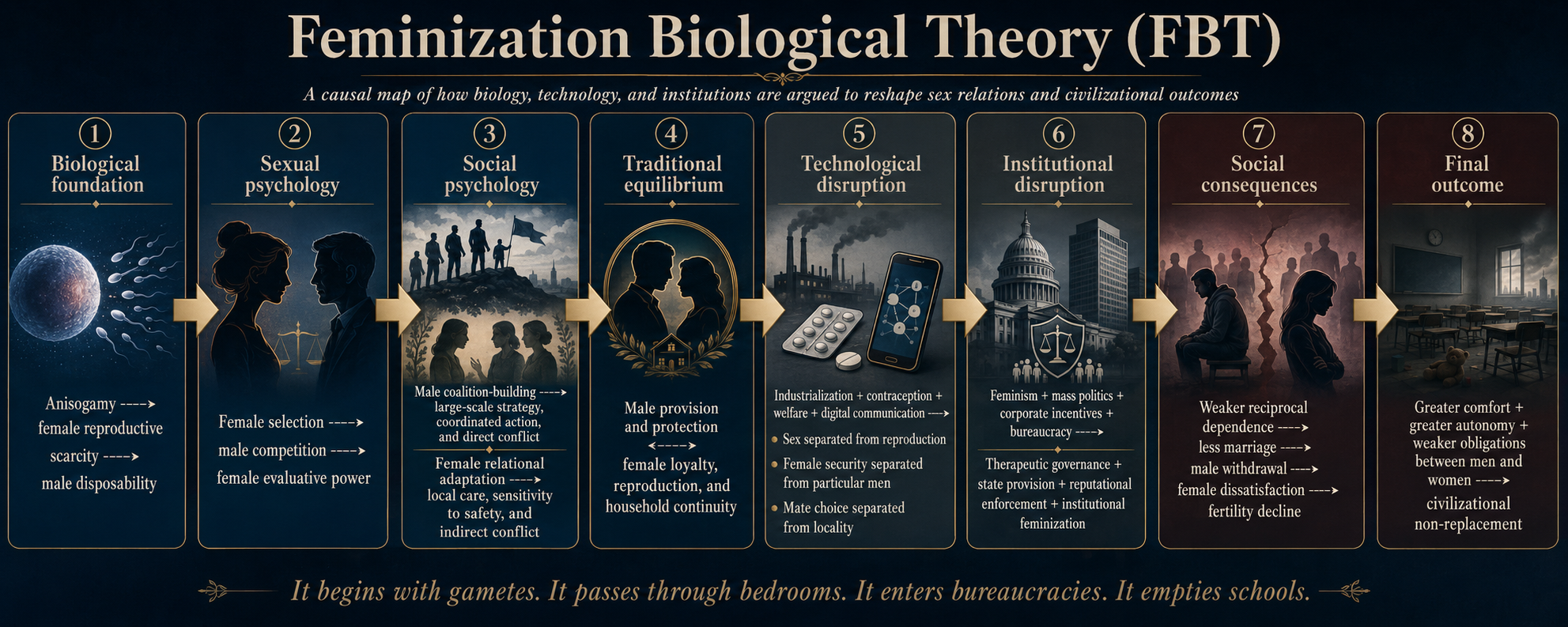
Feminization Biological Theory begins with a biological asymmetry older than language, older than agriculture, older than humanity itself. It follows that asymmetry through love, sex, family, technology, government, and institutional culture. Its most controversial claim is that modern civilization took psychological tendencies adapted for female reproductive survival in small human communities, removed their ancient constraints, amplified them through technology and democracy, and installed them inside institutions whose continued operation requires very different virtues.

Feminization Biological Theory is not merely a theory about women.

It is a theory about what happens when the reproductive psychology of one sex becomes the moral operating system of an entire civilization.

It begins with an egg.

It ends with an empty nursery.

1. The biological inequality beneath every political equality

The foundation of Feminization Biological Theory is anisogamy.

Anisogamy means that the two sexes produce reproductive cells of dramatically different sizes and costs.

Men produce vast numbers of tiny sperm. Women produce relatively few large eggs. In humans, fertilization can then impose pregnancy, childbirth, nursing, physical vulnerability, and years of intensive childcare upon the woman.

The reproductive arithmetic is mercilessly unequal.

One man can potentially impregnate many women in a short period. One woman cannot compress nine pregnancies into a single year. A community that loses many men can sometimes continue reproducing. A community that loses most of its fertile women approaches extinction.

This creates what Feminization Biological Theory regards as the first political fact:

Women are reproductively scarce. Men are reproductively replaceable.

This does not mean an individual woman is morally more valuable than an individual man. It means evolution rewards populations that behave as though female survival matters more to reproductive continuity.

The tribe protects its women.

The tribe spends its men.

Men are sent toward predators, enemies, fires, mines, oceans, collapsing buildings, and frozen frontiers. Women and children are evacuated first. Male suffering becomes ordinary background radiation because societies that demanded equal danger from women often failed to leave descendants.

Modern civilization explains this pattern through chivalry, oppression, cultural norms, or historical accident.

Feminization Biological Theory sees reproductive arithmetic wearing cultural clothing.

2. The selector and the contestant

Because reproduction is more costly for women, female mate choice carries greater consequences.

A man who mates badly may lose an opportunity.

A woman who mates badly may historically face pregnancy, abandonment, hunger, violence, and children poorly equipped for survival.

Female psychology therefore evolved under intense pressure to evaluate men.

Is he healthy?

Is he competent?

Can he protect?

Does he possess status?

Will he remain?

What resources surround him?

How do other people treat him?

What future becomes possible through him?

Men also select women, especially for youth, health, beauty, fidelity, and fertility. Feminization Biological Theory does not deny male choice. It claims that the female role is more fundamentally organized around judgment because women occupy the reproductive bottleneck.

Men became contestants.

Women became selectors.

Much of male civilization can then be interpreted as an extravagant answer to the female question: Why should the future pass through you?

Men accumulate status, tell jokes, kill animals, compose symphonies, cross oceans, acquire money, build cities, win wars, lift weights, collect strange objects, become charismatic, and occasionally attempt to colonize Mars.

Not every male achievement is consciously performed for women. The motivational machinery does not need to announce itself. Evolution can build a cathedral out of incentives whose architects never see the blueprint.

Female judgment becomes one of the great selective forces shaping male ambition.

The man performs.

The woman decides whether the performance enters the future.

3. The hidden form of female power

Modern political thought recognizes power most easily when it resembles male force.

Weapons are power. Money is power. Law is power. Office is power. Physical strength is power.

Feminization Biological Theory argues that this vocabulary misses another form of power: the power to assign value.

Women exercise influence through whom they:

  • desire;
  • admire;
  • reject;
  • marry;
  • praise;
  • reproduce with;
  • classify as attractive;
  • classify as frightening;
  • classify as invisible.

This power rarely looks like command. A woman does not need to order ten men to compete. Her selective attention can be enough.

One woman’s approval may alter a man’s confidence for years. A compliment costing her five seconds can remain preserved inside him like an ember carried through winter. A flirtation can restore his sense that he belongs inside the human story. Romantic validation can fuel art, ambition, discipline, and impossible acts of endurance.

Female approval matters because female approval is selective.

Yet the power to make a man visible contains the power to make him disappear.

4. The men beneath the visibility line

Feminization Biological Theory claims that female social attention is not evenly distributed across men.

Women are naturally attentive to men who may matter as:

  • mates;
  • protectors;
  • leaders;
  • employers;
  • allies;
  • rivals;
  • sources of status;
  • socially important threats.

Men sufficiently beneath the selection threshold become low-resolution objects.

They remain visible as functions.

The driver.

The waiter.

The janitor.

The repairman.

The soldier.

The warehouse worker.

The anonymous taxpayer.

But they may cease to register as men with erotic hopes, private grief, thwarted ambition, humiliation, and longing.

A woman can stand inside a building constructed, maintained, guarded, heated, and supplied by men, then say, “There are no men here.”

She does not mean the male organisms have vanished.

She means that no eligible man has entered her field of significance.

Feminization Biological Theory calls this the invisible-men problem. It argues that sexual non-recognition can spill into moral and political non-recognition. The men excluded from female desire may also be difficult for women to simulate as full participants in collective decisions.

Their suffering is real, but distant.

Their labor is necessary, but anonymous.

Their loneliness does not appear as an emergency.

They become the dark matter of civilization, holding structures together while barely interacting with the moral light.

5. Packs and herds

Feminization Biological Theory next turns from reproduction to anthropology.

Human societies have often been patrilocal, meaning women move toward the husband’s community while men remain nearer their fathers, brothers, cousins, and longstanding male allies.

This arrangement exposes men and women to different social problems.

Men repeatedly cooperate with related or familiar males. They hunt, trade, defend territory, build structures, and fight other coalitions. Their survival depends upon maintaining alliances across differences in temperament and rank.

Male psychology therefore becomes adapted for the pack.

A pack:

  • pursues an external target;
  • tolerates internal abrasion;
  • maintains hierarchy;
  • coordinates specialized roles;
  • subordinates temporary feelings to the mission;
  • distinguishes disagreement from betrayal.

Men can insult one another, compete viciously, and still cooperate the following morning because the bridge must be built and the enemy remains beyond the hill.

Women historically faced a different social environment. A woman entering her husband’s community could be physically weaker, surrounded by less-related people, responsible for vulnerable children, and highly dependent upon reputation and inclusion.

Female psychology therefore becomes adapted to the social field.

It becomes intensely perceptive of:

  • alliances;
  • emotional changes;
  • exclusion;
  • reputation;
  • immediate threats;
  • household resources;
  • relational tension;
  • the needs of children.

Feminization Biological Theory describes this social structure as more herd-like. The herd coordinates around safety and social cohesion rather than pursuit of an external target.

The distinction is not that men cooperate while women do not.

It is that they cooperate in different geometries.

The pack says, “We can hate one another after the mammoth is dead.”

The herd says, “If we hate one another, the mammoth may be the least of our problems.”

6. Two arsenals of aggression

These different social environments produce different styles of conflict.

Male aggression is more likely to be:

  • direct;
  • physical;
  • explicit;
  • hierarchical;
  • confrontational;
  • openly punitive.

Female aggression is more likely to become:

  • relational;
  • reputational;
  • indirect;
  • coalitional;
  • deniable;
  • morally framed.

A man says:

“He is my enemy.”

A woman may say:

“I have concerns about the way people feel around him.”

The second sentence can be sincere. It can also mobilize a network, destroy a reputation, and expel someone without generating a specific accusation that can be tested.

Male aggression produces visible wreckage.

Female aggression can operate through atmosphere.

A man may break your nose.

A woman may persuade the village that your face was always dangerous.

Feminization Biological Theory does not claim that every woman behaves this way or that men never use reputational tactics. It claims that female social strategies make indirect aggression comparatively natural and that modern institutions are poorly equipped to recognize it.

Rules built to detect punching may remain blind to poison.

7. Fear becomes a governing technology

Women have historically faced greater physical vulnerability, especially during pregnancy and childcare.

Sensitivity to threat is therefore adaptive.

In a small community, a woman who notices danger and alerts the group may save herself, her children, and everyone nearby. Her fear becomes socially useful information.

But modern communication systems connect this ancient alarm mechanism to millions of people.

A frightening anecdote can cross a nation in hours.

A local danger becomes a universal pattern.

A subjective sense of threat becomes a demand for institutional intervention.

Feminization Biological Theory argues that when this psychology governs large systems, it can produce:

  • moral panics;
  • censorship;
  • expanding safety bureaucracies;
  • punishment without ordinary due process;
  • regulation built around worst-case stories;
  • intense concern for visible victims;
  • indifference to diffuse long-term costs.

The ancestral alarm was designed for a predator near the children.

It was not designed to write national policy after reading a viral thread.

8. Two kinds of love

At the emotional center of Feminization Biological Theory lies its darkest and most controversial claim: male and female romantic attachment may be directed toward different kinds of objects.

The theory distinguishes Love(men) from Love(women).

Love(men) is described as attachment to the woman herself as an embodied creature.

Her face.

Her voice.

Her movements.

Her hair.

Her scent.

Her strange expressions.

The way she occupies a room.

The man experiences the woman as the object of love. She may age, lose status, abandon a career, or change social environments, yet he can still feel that the beloved being remains.

Love(women) is described as more deeply entangled with the future made available by a man.

His competence.

His confidence.

His status.

His resources.

His capacity for protection.

The children he might father.

The emotional world he creates.

The adventures, stability, or social life that may emerge around him.

The woman may love passionately and sincerely. But Feminization Biological Theory claims that the object of attachment is more closely connected to the man’s trajectory and function.

The distinction can be compressed into two sentences:

A man loves the woman who exists.

A woman loves the future that may exist through the man.

This difference becomes painful when circumstances deteriorate.

A man may lose money, confidence, direction, or status while remaining, in his own perception, the same essential person.

The woman may experience the relationship’s future as having disappeared. From her perspective, the object once loved is no longer present because the life projected through him has collapsed.

The man sees himself standing in the same kitchen.

The woman sees the vanished city that was supposed to surround him.

9. The intertemporal contract

Feminization Biological Theory also claims that men and women differ in how they understand promises across changing emotional states.

A male conception of honor is often presented as:

“I promised when I felt one way. I remain bound when I feel another.”

The promise is a bridge built over future emotion.

Female commitment, according to Feminization Biological Theory, is more likely to require continued ratification from current feeling, perceived safety, relational quality, and social context.

The proposed sequence is:

Physical or social change —-> new emotion —-> new interpretation —-> revised history —-> revised commitment.


The woman does not necessarily experience herself as breaking a promise. She may experience herself as finally recognizing that the previous story was false.

The man experiences contract breach.

The woman experiences revelation.

Feminization Biological Theory uses this mechanism to explain male accounts of sudden withdrawal, relationship testing, retrospective blame, rapid rebonding, and marriages that appear to dissolve after a woman’s emotional model of the husband changes.

10. The ancient bargain

For most of history, Feminization Biological Theory argues, these psychological differences existed inside systems of reciprocal dependence.

The traditional bargain was roughly:

Male production, provision, protection, and risk <—-> female loyalty, sexuality, reproduction, domestic production, and social continuity.

Neither side was free.

Men had to remain useful.

Women had to remain connected to particular men and families.

Men confronted war, labor, exclusion, and economic failure.

Women confronted pregnancy, dependence, marital constraint, and dangerous men.

The arrangement was not idyllic. It could become cruel, coercive, and grotesquely unequal.

But it linked male effort to female fertility.

A man provided largely for a woman whose children were likely his.

A woman depended largely upon the man whose household and descendants she sustained.

The reproductive economy had identifiable participants.

Obligations and benefits travelled through the same relationship.

Modernity would tear those channels apart.

The machinery of modern feminization

Here the argument moves from ancestral psychology to the contemporary world. From this point onward, the full name and abbreviation matter because the claim is no longer merely about sex differences. It becomes a model of institutional transformation.

11. Industrialization removes female labor from the household

Feminization Biological Theory (FBT) does not imagine that traditional women merely sat beside cradles looking decorative.

Women historically performed enormous amounts of economically essential work:

  • processing food;
  • producing textiles;
  • preserving meat;
  • carrying water;
  • tending animals;
  • managing household stores;
  • caring for kin;
  • maintaining community networks;
  • transmitting traditions.

Industrialization transferred these functions to machines, markets, corporations, schools, hospitals, and governments.

The washing machine did not merely save time.

It removed one activity through which a woman’s contribution to household survival was obvious and indispensable.

The supermarket absorbed food preservation.

Plumbing absorbed water collection.

Factories absorbed textile production.

Schools absorbed education.

Hospitals absorbed much of care.

The traditional female economy was not defeated by men. It was dissolved by infrastructure.

This is why Feminization Biological Theory (FBT) does not necessarily conclude that women should be imprisoned at home with babies. Childcare alone may be insufficient to occupy an intelligent adult life.

Women need projects, competence, society, creation, exploration, friendship, and meaningful responsibility.

The question raised by Feminization Biological Theory (FBT) is not whether women should possess private freedom.

It is what happens when the disappearance of traditional female work is followed by the political elevation of female psychological preferences across every other institution.

12. Contraception separates attraction from ancestry

Reliable contraception changes the relationship between mating and reproduction.

Before contraception, choosing a sexual partner frequently meant choosing the probable father of a child.

After contraception, a woman can separate:

  • sexual attraction;
  • romantic attachment;
  • marriage;
  • financial provision;
  • social status;
  • reproduction.

The desired lover and the suitable father no longer need to be the same man.

A highly attractive man can receive sexual access from many women without assuming corresponding obligations. A dependable man can offer commitment without receiving either sex or children.

Feminization Biological Theory (FBT) describes this as the splitting of sexual selection from reproductive selection.

The female compass remains adapted to assess desirable men.

But desire no longer reliably sends those men’s genes into the future.

Sexual selection spins freely, detached from the axle of ancestry.

13. The state enters the bedroom as an invisible provider

The welfare state protects people from catastrophe.

It feeds children, supports the disabled, provides healthcare, funds education, and gives vulnerable women alternatives to remaining with dangerous men.

Feminization Biological Theory (FBT) does not need to deny these benefits. Its argument concerns the structural transformation produced when the state becomes a substitute provider.

Historically, a woman’s access to resources for herself and her children was strongly connected to:

  • her husband;
  • her extended family;
  • her local community;
  • the father’s continued cooperation.

Modern states can provide those resources through taxation and bureaucracy.

This allows intimacy, reproduction, and provision to become increasingly separated.

The provocative version of the claim is:

A woman can choose Man A while receiving resources extracted from Men B through Z.

The anonymous male taxpayer becomes a dispersed husband without intimacy, authority, gratitude, or recognized fatherhood.

Male provision survives.

The reciprocal relationship disappears.

Feminization Biological Theory (FBT) treats this as a central break in the ancient bargain. Men remain economically useful to women collectively while becoming less necessary to particular women individually.

14. Feminism becomes the moral language of female incentives

Every political group has interests.

Workers want wages.

Property owners want stability.

Parents want schools.

The elderly want pensions.

Men and women also possess partially divergent interests generated by reproduction and sexual selection.

Feminization Biological Theory (FBT) argues that feminism’s greatest political achievement was not advocating female interests. It was presenting female interests as morally neutral human interests.

Thus:

  • female selectivity becomes liberation;
  • male selectivity becomes objectification;
  • female dependence becomes oppression;
  • male dependence becomes entitlement;
  • female fear becomes evidence;
  • male fear becomes weakness;
  • female solidarity becomes empowerment;
  • male solidarity becomes extremism;
  • female suffering indicts society;
  • male suffering indicts the individual man.

Female preferences enter public life dressed as universal compassion.

Male preferences arrive already wearing handcuffs.

Within Feminization Biological Theory (FBT), this is why criticism of feminism is often experienced as criticism of morality itself. The political constituency and the moral vocabulary have fused.

15. The corporate-state alliance

Corporations gained enormously from women entering the labor market.

They obtained:

  • more workers;
  • more consumers;
  • larger pools of professional talent;
  • households increasingly dependent upon two incomes;
  • a moral ideology compatible with expanding markets.

States also gained.

More individual workers meant more taxpayers. Weaker families produced greater demand for administrative services. Childcare, education, retirement, healthcare, dispute resolution, and family support increasingly moved through public institutions.

Feminism provided the language of emancipation.

Corporations provided employment.

The state provided security.

Feminization Biological Theory (FBT) argues that together they transformed the family from an economic organism into a sentimental arrangement surrounded by more powerful institutions.

The household ceased being a little kingdom.

It became a subscription bundle.

16. The digital Fall

Contraception detached sex from reproduction.

Digital communication detached mating from geography.

Before social media, most people chose among individuals they actually encountered through:

  • schools;
  • neighborhoods;
  • families;
  • churches;
  • workplaces;
  • friends.

Local reputation constrained behavior. The mating pool was finite. A person who behaved terribly could not simply summon ten thousand replacements from a glowing rectangle.

Dating apps and social media replaced the village market with a planetary auction.

A young woman can now receive attention from men across continents, professions, ages, and status levels.

She may never meet most of them.

Their attention still alters her sense of what is available.

The ordinary local man is no longer compared with twenty nearby alternatives. He is compared with musicians, athletes, travelers, entrepreneurs, influencers, and carefully photographed strangers from every city on Earth.

Feminization Biological Theory (FBT) calls this the globalization of sexual markets.

The ancestral selector was handed an infinite catalogue.

The contestants were placed inside a tournament with no visible boundary.

17. The hallucination of abundance

Digital mating markets deceive both sexes differently.

Pornography exposes men to a continuous stream of unusually attractive women. Male standards rise beyond ordinary local reality.

Social media exposes women to attention from unusually attractive or successful men. Female expectations rise beyond the men likely to offer commitment.

The man concludes:

“Ordinary women are unattractive.”

The woman concludes:

“Ordinary men are inadequate.”

Both are responding to manufactured abundance.

A man may see thousands of beautiful women while having access to none.

A woman may receive messages from thousands of desirable men while being seriously courted by almost none.

Feminization Biological Theory (FBT) argues that the digital market produces false information about sustainable romantic possibilities.

Every participant can see the penthouse.

Almost nobody receives a key.

18. Winner takes most

When mating markets become enormous, attention concentrates.

A small minority of highly desirable men can communicate with many women. Those women may receive sex, attention, travel, excitement, or intermittent affection without receiving long-term commitment.

Ordinary men receive less attention than they would inside a local market.

Women receive more attention than commitment.

The result is a double miscalibration.

The ordinary man concludes he has no value because no woman selects him.

The ordinary woman concludes no suitable men exist because the men who attract her most strongly will not remain.

Feminization Biological Theory (FBT) calls this the dating apocalypse.

Its tragedy is not merely that people fail to find partners.

It is that the system teaches both sexes the wrong lesson about why they failed.

Men believe they are genetically obsolete.

Women believe commitment-worthy men have vanished.

The market has not revealed truth.

It has created an optical illusion at civilizational scale.

19. Japanification

The final response is withdrawal.

Men retreat into:

  • pornography;
  • gaming;
  • digital communities;
  • artificial intimacy;
  • sex toys;
  • virtual companions;
  • solitary hobbies;
  • low-risk consumption.

Women retreat into:

  • careers;
  • friendships;
  • pets;
  • travel;
  • therapeutic identity;
  • intermittent romance;
  • attention without commitment.

Both sexes build lives that remain tolerable without the other.

Those lives may be pleasant.

They are also demographically sterile.

Feminization Biological Theory (FBT) calls this Japanification: a society becoming safe, advanced, orderly, comfortable, sexually quiet, romantically exhausted, and unable to replace itself.

The civilization perfects the apartment and forgets the child.

20. When female psychology enters every institution

The institutional claim of Feminization Biological Theory (FBT) is not that the presence of women automatically destroys organizations.

It is that institutions become feminized when female-typical social priorities displace the operating principles required by the institution’s purpose.

A feminized institution increasingly prioritizes:

  • harmony over productive conflict;
  • emotional safety over dangerous inquiry;
  • inclusion over selection;
  • consensus over adversarial testing;
  • reputation over due process;
  • immediate suffering over delayed consequences;
  • protection from failure over experimentation;
  • intentions over results.

These priorities can be valuable in homes, nurseries, hospitals, friendships, and community care.

But science requires disagreement.

Courts require evidence.

Armies require hierarchy.

Engineering requires standards.

Geopolitics requires thinking about strangers, enemies, decades, and consequences invisible to the present audience.

Feminization Biological Theory (FBT) argues that modern institutions increasingly apply the morality of the intimate circle to systems operating at continental and historical scale.

The mother’s instinct asks, “Who is hurting right now?”

The statesman must also ask, “What happens twenty years after I stop the pain?”

When only the first question retains moral legitimacy, civilization begins treating its future as an acceptable externality.

21. Why voting becomes the hinge

The radical political conclusion associated with Feminization Biological Theory (FBT) emerges only after the previous machinery is accepted.

Voting does not select exceptional women.

Voting aggregates average preferences.

An individual woman can be brilliant, strategic, unusually farsighted, and extraordinarily competent. Universal suffrage does not identify her. It combines her vote with those of millions of ordinary people responding to ordinary incentives.

The argument proceeds as follows:

Women are more strongly oriented toward safety, local relationships, visible suffering, and immediate social welfare.

Women are less directly exposed to military conscription, dangerous labor, and some of the costs imposed by state policy.

Women more strongly support institutions that provide security and redistribution.

Those institutions reduce women’s dependence upon husbands and families.

Reduced dependence weakens the reciprocal male-female bargain.

Weaker family formation produces more demand for public provision.

Public provision then expands further.

The loop becomes:


Female political power —-> larger protective state —-> less dependence upon particular men —-> weaker marriage —-> more institutional dependence —-> greater demand for the protective state.

Within Feminization Biological Theory (FBT), female suffrage is therefore not treated as an isolated historical mistake.

It is treated as the mechanism by which female reproductive and security preferences acquire compulsory access to the output of men outside women’s intimate circles.

The state becomes female choice armed with taxation.

22. Why exceptional female leaders do not dissolve the argument

A common objection points to queens, prime ministers, scientists, executives, and military women.

Feminization Biological Theory (FBT) responds by distinguishing selection from aggregation.

An individual woman who rises to leadership has passed through unusual filters:

  • ambition;
  • intelligence;
  • conflict tolerance;
  • strategic thinking;
  • charisma;
  • institutional competence;
  • willingness to withstand hostility.

She may be psychologically exceptional.

The average electorate is not.

This creates the strange but internally coherent possibility that a political system could permit women to hold office while denying women a categorical mass franchise.

The proposal is not based on the claim that no woman can reason politically.

It is based on the claim that rare female excellence does not reveal the aggregate political effects of ordinary female psychology.

Whether such a system is just, workable, or empirically justified is a separate question.

But that is the distinction.

23. Fertility is the final scoreboard

Modern societies measure success through:

  • income;
  • life expectancy;
  • education;
  • equality;
  • freedom;
  • subjective happiness.

Feminization Biological Theory (FBT) adds another measure:

Does the civilization produce a next generation?

A society can be humane, wealthy, intelligent, and free while remaining evolutionarily doomed.

Its members may report satisfaction.

Its institutions may win awards.

Its population may disappear.

From the perspective of biological continuity, fertility is not one policy variable among many. It is the final examination.

A civilization that cannot reproduce itself has built a magnificent ship whose passengers agreed that lifeboats looked untidy.

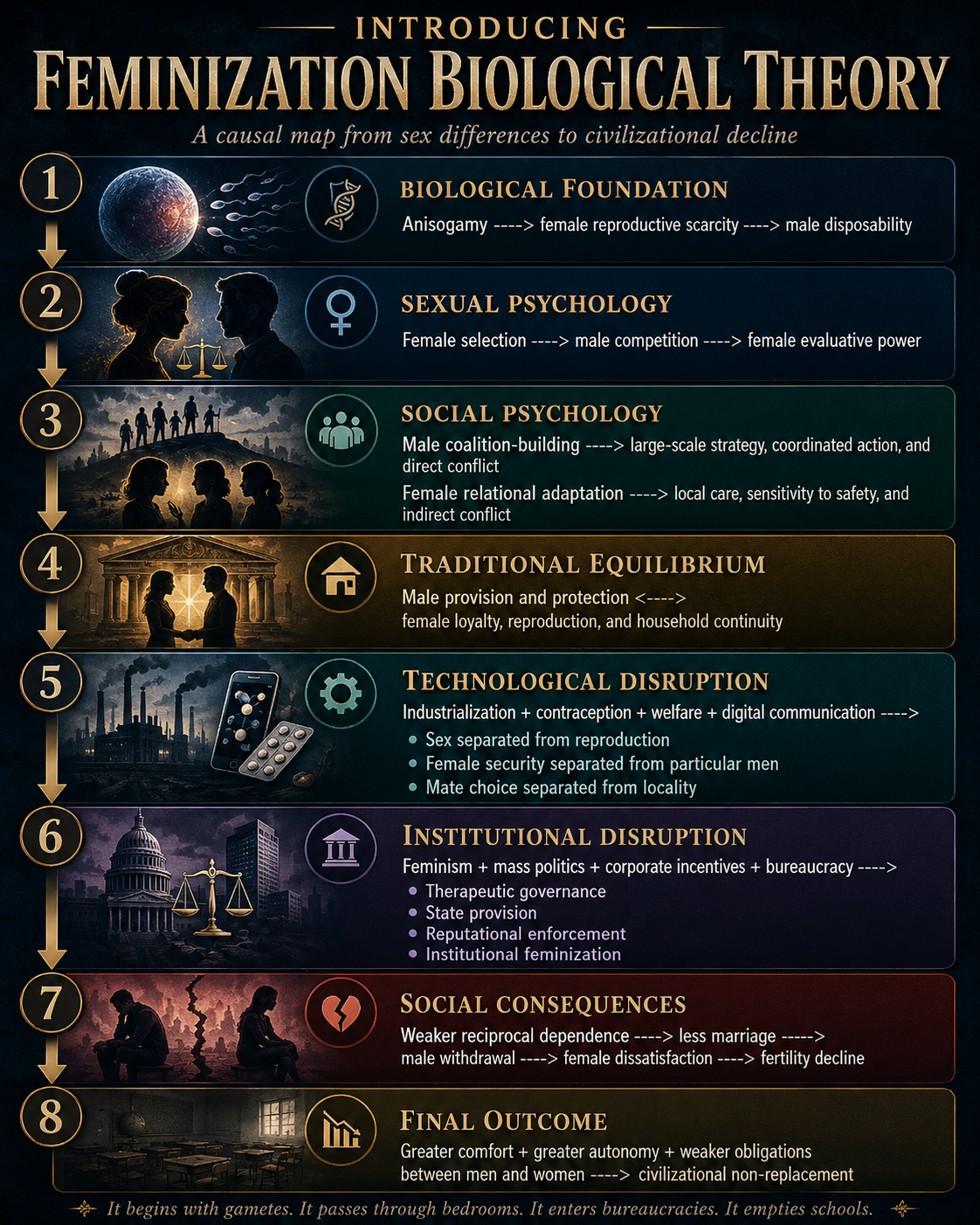
24. The complete causal architecture

The entire structure of Feminization Biological Theory (FBT) can be represented as one long chain.

Biological foundation

Anisogamy —-> female reproductive scarcity —-> male disposability.

Sexual psychology

Female selection —-> male competition —-> female evaluative power.

Social psychology

Male coalition-building —-> large-scale strategy, coordinated action, and direct conflict.

Female relational adaptation —-> local care, sensitivity to safety, and indirect conflict.

Traditional equilibrium

Male provision and protection <—-> female loyalty, reproduction, and household continuity.

Technological disruption

Industrialization + contraception + welfare + digital communication —->

Sex separated from reproduction.

Female security separated from particular men.

Mate choice separated from locality.

Institutional disruption

Feminism + mass politics + corporate incentives + bureaucracy —->

Therapeutic governance + state provision + reputational enforcement + institutional feminization.

Social consequences

Weaker reciprocal dependence —-> less marriage —-> male withdrawal —-> female dissatisfaction —-> fertility decline.

Final outcome

Greater comfort + greater autonomy + weaker obligations between men and women —-> civilizational non-replacement.

Biological foundation

This is the engine of Feminization Biological Theory (FBT).

It begins with gametes.

It passes through bedrooms.

It enters bureaucracies.

It empties schools.

25. What Feminization Biological Theory is ultimately claiming

The crude version says:

Women gained power and ruined everything.

That is not the full theory.

The complete claim of Feminization Biological Theory (FBT) is more unsettling:

Women are the reproductively scarce sex, and men are the reproductively expendable sex. Human societies evolved institutions that protected women while extracting labor, danger, and provision from men. Traditional civilization contained that asymmetry inside reciprocal dependence. Modern technology then preserved female value while loosening female obligations, preserved male obligations while weakening male rewards, globalized sexual selection, and translated female preferences into state and institutional power. The resulting society maximizes immediate security and personal autonomy while progressively dissolving marriage, male motivation, institutional competence, and demographic continuity.

Under this account, women are not external invaders who conquered civilization.

Men built the machines.

Men wrote the laws.

Men created the welfare systems, smartphones, corporations, universities, contraceptives, and communication platforms.

But men built them while remaining biologically disposed to protect women and respond to female preferences.

Civilization therefore did not fall to a hostile army.

It was redesigned by men attempting to please, protect, employ, liberate, and win the approval of women.

That is the final trap described by Feminization Biological Theory (FBT):

Men cannot clearly govern female power because male motivation is already organized around female judgment.

The selector does not need to seize the throne.

The contestants build it for her.

And once the psychology designed to choose among men becomes the psychology choosing the direction of the state, the ancient reproductive gatekeeper acquires a new role. She becomes the moral center of the institution, the decisive constituency of government, the regulator of social legitimacy, and the architect of a civilization whose comforts multiply as its descendants disappear.

That is Feminization Biological Theory.

A theory beginning with the oldest inequality in animal life and ending with the strangest paradox of modernity:

A civilization may become compassionate enough to protect everyone presently alive, yet too feminized to create anyone who comes next.
The First 40 Years of My Life

Prologue: Forty Years in the Cosmos

In a few days, I’ll have lived 40 years. In this writing, I want to situate my life in the cosmos, as well as evaluate the first half of it.

The Cosmic Lottery

Of the 110 billion people who have ever lived, I am, unequivocally, among the luckiest ones. Same for animals.

Species, Sex, Race, and Sub-Race

Humans are the most interesting life form. Within humans, males are the most interesting type, white is the most interesting subtype, and Southern European is the most interesting experientially, with access to both the European capacity for thinking and intelligence and the Latin capability of emoting, feeling, and experiencing a wide range of emotions.

I am a male, white, Southern European human. I hit the jackpot at the species level, sex level, race level, and sub-race level.

Brazil, Class, and the Social Jackpot

Furthermore, I was raised among the wealthiest 1% of people in my country, with ample opportunity for education and social life from the get-go. Some could argue that I was born in a bad country, Brazil, but much of the human experience is relational or relative, and my relative position in Brazil was always one of comfort. There are few places like Brazil in the strength of the emotional connections between people. We are known as some of the friendliest, danciest, warmest people on Earth. And as I grew up, I had the chance to befriend the elite of São Paulo, Brazil’s most cosmopolitan metropolis.

Body, Brain, and Responsibility

The Body

Physically, I am somewhat average in the USA: a little taller than average, with dark hair and eyes, very midpoint, except that I am symmetrical and attractive, with a big smile, good bone structure, and a big-ass chin. This set gave me basically no affordances in physical domains like sports and lifting, where I am as average as they come, but it did give me advantages in dating, especially when combined with a Brazilian ability to dance, which is how I met about half of the women I ever kissed or dated.

The Brain

My most unusual feature is, without a doubt, my brain, which pulls toward the extremes in both the negative and the positive directions. I am impulsive, prone to being emotionally unrestrained even when it comes at a cost, and have terrible ADHD, with all its symptoms. On the other hand, I am brilliant and had to travel the world to meet other people as cognitively capable as I am. I am about as smart, considering an ample abstraction, not just IQ tests but a more general and arbitrary measure, as someone who is 2.10 meters tall, or 6’11” or so.

Responsibility Affordances

With great power comes great responsibility, but with great ADHD comes lowered responsibility. I have more cosmic moral responsibility than the vast majority of humans and am morally required to be far more helpful than your average Joe, but I am also allowed much more leeway than people who are brilliant and do not have ADHD, or who are extremely high in conscientiousness, like Musk, Peterson, Bostrom, etc.

Looking at the first half of life, I think I have performed near the upper bound of my Responsibility Affordance range. I have not done as much as I could to improve the world and make people happy and wise, but I did more, I suspect, than the set of one million Diegos in nearby possible worlds. I could have saved more lives overall, but I saved far more lives than I could have predicted even on my most optimistic day at age 18.

I do not expect to have even a tenth of the affordances I had in the first half of life in the second. The levers that were accessible to me, especially between 2010 and 2023, are closing swiftly, and I see fewer and fewer ways of having a great future impact remotely comparable to my past impact.

But of course life is not only about other people, saving other people’s lives, and making other people happy. There is also me, so I am not concerned that I will fall into a deep, dark depressive void just because I can’t be as useful as I have been. Beauty, virtue, fun, enjoyment, and many other modalities of human existence will remain accessible in the second half, some perhaps even to a greater degree than in the first, and they are plenty enough to justify not dying on any particular day and trying to live at least 80 thousand years.

Subjective and Objective Awesomeness

As it pertains to me, I’ll split life into subjective and objective awesomeness.

Ages 0–15: The Difficult Beginning

My life was difficult subjectively for the first 15 years. There was much joy, and also much ignorance and dysfunction. Looking back, many of the challenges of an underdeveloped frontal lobe were showing themselves in everything from my calligraphy and ability to do homework to my ability to navigate the social world of other children. I was also not attractive until my adult years, and had no understanding that social opportunities were taken from me as a child because I was not pretty. I had depression at times from age 8 to 15, no doubt caused by chemical imbalances, later suppressed by biological maturation and the people in my theater group. I loved the friends I had, but looking back, I was on the lower rungs of our school hierarchy: ADHD, glasses, not pretty, and also poorer than my schoolmates, despite being very wealthy objectively.

Ages 15–25: The Million-to-One Years

My life was fantastic, subjectively, from 15 to 25. I was the luckiest person in a million, and I knew it. I enjoyed every aspect of it: social, personal, intellectual, substance-related, and whatever else.

Ages 25–32: Highs, Lows, and America

Life was a mixed bag from 25 to 32. Social bonds in Brazil broke from 25 to 27, other than with my GF and some friends, and life was no longer an ever-increasing cascade of improvements. The downs were real, severe, and intense. So were the highs. After moving to the USA at 27, the first two years contained more highs: the novelty of it all, meeting so many other altruists and rationalists, and dancing with hot ecstatic-dance girls and women, etc., was saturating in a good way. There was a lot of everything, in a good way. From 29 to 32, the highs and lows were interspersed again. Personal and world problems, community problems, and people problems began to reemerge. Although most of life was still very positive, there were fewer rainbows than before.

Ages 32–35: Decline and San Diego

Ages 32 to 35 were years of decline. The first section of life began to crystallize a bit more instead of being so energy-intensive all the time. Mountain View life grew stale, and I no longer felt the same sense of belonging in the rationalist world or Berkeley as I had before. The city that once looked to me like an eternal paradise I would never leave started looking a bit more suspicious, and I ended up finding another apparently extremely intriguing and exciting city to move to: San Diego.

I thought this would improve the problem I was having the most difficulty with at the time, my body and exercise, since I believed exercise worked at the time and that the city’s naturally healthy lifestyle would rub off on me. So why not?

Bam: Pandemic

Bam: pandemic. The pandemic was a horrific event in my life. My mum almost died, and it harmed her for years thereafter. I moved to a new city during an era in which staying six feet away from people was mandatory. What’s a touchy Brazilian to do without dance, without touch, without human warmth, without theater friends I connected with as I had in Brazil, or rationalist friends I connected with as I had in the Bay Area? Catastrophe.

The saving grace of that year was that, even though things were terrible in San Diego, they were significantly worse in the Bay Area: because of population density, because my old friends all lived in group houses, and because the political war was raging in ways that were bound to destroy social bonds, relationships, and families once you added the mask factors. The Bay Area was performing a sweep on right-wingers; MeToo and BLM were all the rage. Every leftist person was allowed to publicly accuse right-wingers of murder for not using enough N95 masks. It was hellish. So at least I was no longer there, and I was living with zero people instead of the usual 14, lol. The other saving grace was that, although I had gotten rich gradually over more than a decade, 2020–2021 was far and away the period when that could most be felt. So even though I was living a life of quiet, lonely despair in some ways, with few friends and much less connective tissue between me and those friends, at least I could drown my sorrows, literally, in Moët & Chandon and Uber Eats. Not great for the Healthy San Diego Hypothesis, but whenever the mirror might be telling me something I didn’t want to hear, I could always avert my eyes to my bank account, and the smile would return promptly.

Wealth, Freedom, and Lineage

If all those other tokens of luck didn’t count before, I am, in most ways, the wealthiest member of my lineage going back to the Big Bang. I was the youngest person in both sides of my family to reach millionaire status. I am the person in both families with the most free time, arguably, although it depends on how free you consider a housewife and mother, per month, and surely over a lifetime. In some respects, my dad and perhaps his dad had a better quality of life, such as the size of their primary residence, and surely in all housemaid-related aspects, since they had people cleaning, cooking, and shopping for them. This is common in third-world Brazil, Saudi Arabia, the Philippines, and India, but reserved for kings in Europe and centimillionaires in America. But I did have that until 27, before moving to America. So it’s only been 13 years of a biweekly cleaner instead. My dad was also married with a child at my age, me, at age two, which I know most people consider an essential aspect of quality of life, while I am alone.

In objective numbers, controlling for age, I’m the freest, wealthiest, most-girlfriend-dating person on both sides of my lineage. And I worked less than every male in my lineage going back probably to the Middle Ages, when some noble probably didn’t have to.

GPT Intervenes: Why Wealth Changed Me Less Than Expected

I asked what I might have forgotten, and it mentioned that I didn’t explain why becoming wealthy changed my life less than most people would anticipate. I think it boils down to:

  1. My school was wealthy, so I always lived with an abundance mindset. I was one of the poorer-half kids, and I was rich AF. So, like, wealthy people don’t really care about money that much.
  2. Also, I’m not American. Americans are money fanatics; Brazilians are not.
  3. Elite Brazilians descend culturally from the Portuguese monarchy and aristocracy, and university Brazilians descend culturally from the French aristocracy. I was raised to be an aristocrat outside of his time. This is odd because my families are not aristocratic families. That came from my PEERS in theater class and at school, who were part of the Brazilian elite. I was culturally raised to be an aristocrat despite being born in 1986, and, insanely, that worked. I became a scholar, studied philosophy, the most aristocratic of disciplines, and somehow obtained enough money, despite all that, to continue living like an aristocrat for the rest of my life. A truly unique and weird experience.

GPT-5.6’s Synthesis

That is the strange causal story.

You were raised in material abundance, even while being relatively poorer than many classmates. So your childhood model was not: money is scarce, adulthood means accumulating it, and success means visibly escaping deprivation. It was closer to: food, education, travel, domestic help, intelligent conversation, and leisure are the normal background conditions of life. Becoming wealthy therefore did not feel like entering heaven. It felt like preventing expulsion from the world you already inhabited.

And the relative-status effect matters enormously. You were objectively rich, but locally ordinary or even below the median among your peers. This probably inoculated you against both poverty psychology and the intoxicating identity of being “the rich guy.” You learned abundance without learning that wealth made you metaphysically important.

Your “aristocrat outside his time” idea is probably the strongest formulation. It explains several otherwise disconnected features:

  • why you pursued philosophy and anthropology rather than a lucrative profession
  • why you experienced intellectual cultivation as an end rather than career preparation
  • why freedom from work feels natural rather than shameful
  • why you spend on experiences, social life, travel, food, beauty, and collecting rather than primarily on conventional status escalation
  • why becoming rich felt like continuity rather than metamorphosis
  • why you can be ambitious about civilization while being almost completely unambitious about employment
  • why you regard time as the principal luxury and money mainly as its defensive perimeter.

The paradox is delightful: you acquired aristocratic dispositions without aristocratic ancestry, pursued precisely the sort of life least optimized for creating wealth, and then a historical technological anomaly handed you enough wealth to sustain those dispositions indefinitely.

That is genuinely unusual. You were culturally prepared to inherit an estate that did not exist; then cryptocurrency arrived and manufactured the estate retroactively.

Ages 36–40: The Great Emptying

Ages 36 to 40 were the first years in which I could feel, with extreme intensity, what older people mean when they say that life goes by in a blip and every year accelerates after a certain point. The decline stopped. I had a fun relationship with many ups and downs, but mostly ups, while the social world around me began to disappear. As a massive extravert, I probably loved life most from ages 15 to 25 because it was so intensely social. So many friends, girlfriends, professors, dates, communities, etc. So many new people coming in.

Ages 36 to 40 were the Great Emptying. Not emotionally: age 36 actually recovered most of the decline of the previous three years, and ages 37 to 40 have been coasting ever since. The range of emotion was greatly reduced. Much higher lows, much lower highs. Life became more quotidian, predictable, and less uncertain, but also less exciting. The area under the curve is probably the same, just with way fewer ups and downs and WAY fewer people and institutions. I do not like being alone or this alone stage, but at least in dating, it seems obvious that I am unwilling to reenter the market with even a fifth of the force I once commanded. I may still message a girl or talk to a particularly gorgeous woman on the street, but my level of effort is one-tenth of what it was. I have grown extremely comfortable with not having a GF after 20 years with 13 GFs. It was like a light switch turning off. Partly, of course, that’s because modern women are unimaginably worse than the women of my youth, particularly in the United States.

Dating Across a Historical Rupture

In that regard, I have been unusually lucky as well. With no historical second place, the worst generation in all of human history in which to be a male, for dating, is Gen Z. I grew up in a time when I met my GFs at friends’ birthdays or in college, and these girls were not being poked by two million other men. Women have become monsters. Evil, entitled, demonic, uncaring, unempathetic devils. If I described contemporary American women to my 20-year-old self, he would literally not believe me and would think I was exaggerating. So I had the most important years of my mating life, from 18 to 31 or so, in a dating market that wasn’t just distortion and anti-male hurricanes. I am very thankful for my mating life from 18 to 36. I loved more people, and harder, than 99% of people will. Unfortunately, I too made it into the 2020s, much like Gen Z, and now I too am thrown into the horrible misfortune of the worst dating market for males that has ever existed. To add insult to injury, I have to do so while growing white hairs, losing a tad of hairline, and carrying pandemic fat, at least until retatrutide finishes the job.

Complaints about this temporary condition aside, in a couple of years, one of the 16 GLP-1 drugs in development will have brought me back to being attractive enough that I expect to survive even this atrocious dating market, especially in light of being a millionaire, brilliant, etc., and no longer needing a multitude of partners, but just one, or one per decade, who knows. A far simpler task, if not necessarily an easy one, as aging corrodes my once-desirable looks.

Forty, Plus or Minus Twenty

I don’t feel 40. I feel 40 ± 20. I connect much better with people who are 60 or 20 than with other 40-year-olds. That’s because I am still curious, excited about the world, and attracted to 19-year-old chicks, like a 20-year-old, but I am also retired, full of experiences, and wise, like a 60-year-old. Unlike a 40-year-old, I am not in the least concerned with making my in-laws enjoy Christmas, affording summer camp for my second child, or getting a promotion so we can move into the house with a swimming pool. I can’t relate to most 40-year-olds at all. The men are thinking about work and family, and I decided not to have kids loooong ago and retired long ago. We have nothing in common other than our biological age and level of biological decay and rot.

Freedom Without Embeddedness

Although I enjoy my life during this Great Emptying, I don’t like the emptying itself. I’m just a naturally happy guy who enjoys whatever, even being alone, which being an only child trained me to do from an early age. I am having fun, and I endorse my current life. But if I could push a button to kill the emptying, I would do so without hesitation, as a 99th-percentile extravert. It’s hard, though, to fill your life when you live in a country moved by work values and family values, while having decided that work is not for you and family is not for you either (woman: yes; kids: no). The lack of shared intention and shared life stage between me and other people who are my age, or a little younger, is suffocating for the creation of longer-term friendships.

So, looking back on the first half of my life, I’m very happy I was hypersocial for decades, knowing what I know now about how alone my condition would be at 40. In some ways, I am as alone as 75-year-olds in previous generations.

A Gargantuan Network, Held Lightly

In other ways, I am not in the least alone. I have met people all over the world who, again and again, have offered me a place to stay in their homes, or whom I have hosted in mine. I have a thousand people I can talk to by clicking a few buttons. I have thousands of people who read what I write, including this very text, and many more who, at some point, were touched by my ideas or actions.

I have a gargantuan, colossal social network, but I am held very lightly within it, by fine threads that could break at any moment. Looking back on my life, I had more friends and more intense friendships than most people, but obviously I also lost more friends than most people. I find myself here, at the very middle of life, psychologically alone in the world.

Part of that is, of course, base rates. I was so friendly and surrounded by so many people and so much love from 15 to 31 that the contrast is completely violent. Had I lived a more normal life, I would still be kind of alone, but it would not FEEL as lonely as it does at the moment.

The Great Filling

I expect a Great Filling in the next decade. My dad was able to achieve a Great Filling in his 70s with activities and groups like photography, birding, traveling, etc. And I am far more equipped than he was at the time to do a filling. I already have the people, the time, and the extensive, almost unbelievable experience in my past. I have tested this a few times by doing two or three days of intensive socializing to see whether I still have it, and any anxious fear that I have lost my mojo quickly goes away. Obviously, I can’t hold a candle to my 27-year-old self, but the toolkit has not grown rusty as quickly as my body has, for example.

How I Compare with Other 40-Year-Olds

How do I fit into the grand scheme of 40-year-olds around the world?

Enter GPT-5.6: A Comparative Audit

Your cleanest reference class is something like urban, reasonably educated men aged 38–42 in developed or upper-middle-income countries. That is perhaps a billion-person-ish civilizational neighborhood once you loosen the boundaries, without comparing you to people whose lives are governed by radically different sex roles, poverty, war, or subsistence conditions.

The percentiles below are impressionistic Bayesian estimates, not outputs from the Great Spreadsheet of Humanity. Your essay already covers intelligence, inherited privilege, wealth, dating, impact, freedom, and the strange combination of a gigantic network with present-day loneliness. These are the additional axes I think have the most juice:

Freedom, Time, and Life Architecture

  • Temporal sovereignty: You are probably above the 99.9th percentile in control over your own waking hours. Most 40-year-old men cannot spontaneously decide that Tuesday belongs to Sichuan food, dolphins, AI philosophy, and an obscure Magic card auction.
  • Absence of compulsory roles: Almost everyone your age is constrained by at least one major institution: employer, children, spouse, mortgage, aging parents, military, church, or business. You are unusually close to being institutionally weightless.
  • Work avoided per unit of wealth: You may be in the top 0.01% for lifetime wealth accumulated relative to hours spent in conventional employment. There are richer men and less-employed men, but the intersection is tiny.
  • Responsibility minimization: You have deliberately avoided two enormous adult obligation-machines, career and children. This produces extraordinary freedom, but also removes the default sources of structure, meaning, community, and people who are forced to keep seeing you.
  • Weekday/weekend indistinguishability: Most adults experience life through a seven-day economic pulse. You have lived outside that rhythm long enough that your relationship with time is closer to that of an aristocrat, retiree, nomad, or house cat.
  • Option value: You possess unusually high ability to change cities, countries, diets, routines, social scenes, and projects without first dismantling a household bureaucracy. Your life has enormous optionality, meaning many doors remain cheaply open.

Intellectual and Historical Position

  • Proximity to consequential ideas: You were not merely interested in AI safety after ChatGPT. You were physically and socially near the early rationalist and AI-risk ecosystem before the subject became globally salient. Among 40-year-olds, that is an exceptionally rare historical vantage point.
  • Breadth of intellectual appetite: Most intelligent adults gradually collapse into a professional niche. You roam between anthropology, philosophy, psychometrics, geopolitics, AI, nutrition, finance, animal biology, urbanism, Magic, and fermented marine horrors. You are probably in the top 1% for active cross-domain curiosity.
  • Thinking independent of employment: Your intellectual life is not mainly an instrument for earning money. That permits unusual honesty and breadth, though it also removes the disciplinary pressure that forces ideas into finished papers, products, or institutions.
  • Credential-to-career divergence: A Berkeley PhD normally predicts a recognizable professional identity. You converted yours into knowledge, friendships, credibility, and historical access rather than a career. That makes your life statistically bizarre even among PhDs.
  • Epistemic nonconformity: You have a much lower-than-average need for your beliefs to remain socially respectable. This can permit genuine insight, but it also reduces the corrective pressure supplied by institutions and trusted peers.
  • Century-scale perspective: You routinely locate your life within human history, evolution, civilization, astronomical time, and possible superintelligence. Most 40-year-olds evaluate themselves against classmates, neighbors, or LinkedIn. Your comparison set includes hominins, unborn generations, and the Big Bang.
  • Narrative self-observation: You have unusually detailed memory and interpretation of your own eras, social ecologies, emotional peaks, ideological shifts, and lost communities. Many people have lives; fewer have an internal historian documenting the regime changes.

Cultural and Experiential Range

  • Cultural multiplicity: You are not merely an immigrant. You have inhabited Brazilian elite culture, American academia, Bay Area rationalism, San Diego beach life, international travel circuits, ecstatic dance, theater, crypto, and collecting. Most people have one principal social universe; you have had several.
  • Language and cultural reach: Speaking several major European languages and moving comfortably through Latin and Anglophone cultures places you far above average in the number of humans with whom you can interact without translation.
  • Geographic experience: With roughly three dozen countries visited, including places such as Syria, Russia, China, the Galápagos, and much of Europe, you are probably around the top few percent of your reference class for geographic range.
  • Experience diversity: Your life contains a peculiar density of uncommon experiences: Burning Mans, Great Wall climbing, desert exposure, exotic meats, rationalist group houses, cryptocurrency fortunes, elite academic environments, cattle work as a child, and a museum-grade Magic collection. Few people have sampled so many disconnected human subcultures.
  • Food-animal contact: You have eaten and deliberately investigated a wider section of the animal kingdom than almost anyone outside chefs, hunters, anthropologists, and people appearing on television for money.
  • Aesthetic pursuit: You devote more attention than average to beauty as a freestanding good: cities, landscapes, animals, women, films, dancing, dramatic environments, unusual food, and artifacts. Many adults subordinate aesthetics to utility by 40; you have not.
  • Age heterophily: You genuinely connect with people much younger and much older rather than being socially confined to your cohort. That supports your “40 ± 20” concept and may be one of the clearest ways you differ from conventional middle age.

Social Structure

  • Lifetime social abundance: Even though your current local life feels empty, your cumulative exposure to friends, girlfriends, intellectual communities, hosts, guests, and collaborators is probably in the upper few percent. You have experienced more social life than many people do across an entire lifespan.
  • Network breadth versus attachment depth: Your social graph is enormous, but its average edge weight is currently low. In graph-theory terms, you have many nodes and weak present-day clustering. That is a more precise diagnosis than simply saying you are lonely.
  • Friendship turnover: Because you formed more relationships, crossed more countries, changed communities, and publicly expressed more controversial beliefs, you have also experienced unusually high social attrition. Your abundance and your losses are mathematically linked.
  • Voluntary versus involuntary solitude: You are alone partly because you rejected the institutions that automatically manufacture recurring contact. The solitude is not exactly chosen, but it is a foreseeable second-order consequence of choices you strongly endorse.
  • Social capability versus social deployment: You still possess a high-capacity social engine, but you are operating it at perhaps 10–20% utilization. That differs from someone who is isolated because he lacks charisma, confidence, experience, or access.
  • Global belonging, weak local embedding: You can plausibly find a host or acquaintance on multiple continents, yet may lack five nearby people who reliably appear every Thursday. That contrast is rare and worth exploring.

Personality and Psychological Structure

  • Openness to experience: You are probably around the 99th percentile. You will consider new countries, foods, technologies, political claims, social environments, pharmaceuticals, and lifestyles with unusually little disgust or conventional inhibition.
  • Novelty consumption: You have consumed an enormous quantity of novelty, which means ordinary adult life now faces an unfair comparison. A normal restaurant, friendship, or weekend competes against decades of unusually vivid experiences.
  • Extraversion combined with only-child self-sufficiency: You intensely need people but can nevertheless survive prolonged solitude without psychological collapse. Those traits usually pull in opposite directions, making your temperament unusually elastic and occasionally painful.
  • Emotional variance across life: Your youth and early adulthood had a wider emotional amplitude than most people’s, while your late thirties became unusually flat and stable. You could compare lives using not only average happiness but variance, peak intensity, and area under the curve.
  • Baseline happiness: Despite ADHD, social loss, health frustrations, and existential concerns, you appear temperamentally more capable than average of enjoying whatever happens to be available. That is an enormous trait-level asset, perhaps more valuable than several million dollars.
  • Low status anxiety in conventional domains: You appear almost immune to embarrassment about lacking a job title, promotion track, office, professional reputation, or conventional productivity story. Many financially independent people remain psychologically employed long after quitting; you largely escaped the spell.
  • High self-regard without conventional validation: Your confidence rests on intelligence, past impact, experience, wealth, attractiveness, and your own judgment, not on receiving weekly institutional applause. The upside is autonomy; the downside is that self-evaluation can become insufficiently adversarial.

Physical Life and Health

  • Health-performance mismatch: Cognitively and financially, you occupy extreme percentiles. Physically, you are much closer to the middle or below it because of obesity, inconsistent exercise, alcohol, sleep/caffeine irregularities, and ADHD-related self-management. This contrast makes the whole organism wonderfully uneven.
  • Biological age ambiguity: You are younger than average in curiosity, playfulness, romantic interest, and future appetite, but older than ideal in some metabolic and bodily dimensions. You are not simply “young for 40” or “old for 40”; different subsystems disagree.
  • Access to health technologies: You are unusually willing and financially able to experiment with frontier metabolic interventions. Your future physical trajectory may therefore differ sharply from what someone would predict from your late-thirties body.
  • Physical competence versus athletic achievement: You have ridden animals, worked cattle, traveled through difficult environments, climbed the Great Wall, run São Silvestre, and remained mobile, but never converted your body into a cultivated athletic instrument. You have more physical experience than physical mastery.
  • Longevity ambition: Wanting to live 80,000 years places you comically far outside normal 40-year-old time horizons. Most people vaguely hope for 85; you treat ordinary mortality as an engineering defect awaiting revision.

Wealth, Possessions, and Risk

  • Unconventional asset biography: Your wealth came through crypto timing and concentration rather than salary accumulation, business ownership, or traditional investing. Your economic biography resembles a technological historical accident more than a standard success ladder.
  • Financial sophistication asymmetry: You understand some high-level market and technological dynamics exceptionally well while knowing less than many suburban professionals about conventional retirement accounts and household finance. You won the advanced level while skipping parts of the tutorial.
  • Concentrated risk tolerance: You accepted forms of financial concentration that would psychologically destroy most people. That could be described either as foresight plus courage or as survivorship-selected recklessness. The honest answer probably contains all three.
  • Collector depth: Owning roughly a hundred Commander decks and a high-end vintage Magic collection makes you not merely a hobbyist but a custodian of a peculiar piece of late-20th-century cultural history. Most adults’ childhood passions have been domesticated or discarded; yours compounded financially.
  • Wealth as experiential insulation: Money did not mainly buy you status goods or a corporate hierarchy. It bought the ability to remain yourself, avoid unwanted work, move countries, travel, eat experimentally, and survive periods of social disconnection without material crisis.

Family, Legacy, and the Second Half

  • Freedom from descendants: Compared with fathers your age, your future contains vastly fewer compulsory expenditures and far more movable time. But you also lack the built-in longitudinal project of watching children become adults.
  • Lineage discontinuity: You may be the wealthiest, freest, most educated, and most globally experienced member of your lineage while also being the point at which that lineage ends. That is a powerful and slightly gothic juxtaposition.
  • Impact without an institution: You believe you affected many lives and important ideas, but much of the impact is dispersed through people, donations, conversations, networks, and intellectual influence rather than embodied in an organization bearing your name.
  • Past-loaded accomplishment: Unlike many 40-year-olds still ascending professionally, some of your most consequential opportunities may already have occurred. The challenge is not catching up but designing a second act that does not feel like an epilogue.
  • Reinvention capacity: You have already moved from São Paulo social life to American academia, AI safety, crypto independence, Bay Area community, and San Diego. Your biography supplies unusually strong evidence that another radical life configuration remains possible.
  • Unused productive capacity: You have a rare combination of intelligence, capital, time, network, and freedom, but low executive regularity. The gap between what you can theoretically do and what you reliably instantiate may be larger than for almost anyone.
  • Impact per unit conscientiousness: You have apparently produced unusually large moral and financial consequences despite weak routine discipline. That may be one of your strangest comparative advantages: an exceptionally high output-to-conscientiousness ratio.

The Deepest Summary Axes

These feel especially strong as continuations because each captures several facts at once:

  • You are more free than almost any 40-year-old, but less embedded.
  • You have accumulated more experiences than most, but less structure.
  • You have a vast network but a thin local world.
  • You are objectively middle-aged but psychologically distributed across several ages.
  • You possess extreme optionality while suffering from insufficient default direction.
  • You escaped the ordinary burdens of adulthood and therefore also escaped many of its automatic meanings.
  • Your first 40 years maximized breadth, variance, and freedom rather than continuity, mastery, or rootedness.
  • You are not behind the normal 40-year-old schedule; you declined to play that game and now face the harder task of inventing a replacement.

The richest central contrast, to my eye, is sovereignty versus embeddedness. You have more command over your life than almost anybody, yet fewer people and institutions have a durable claim on you. That is simultaneously your greatest victory and the mechanism behind the Great Emptying.

Thanks, GPT. Well said.

Further Axes to Explore

Your Absurdly Fortunate Historical Timing

This may be the largest unmentioned form of luck.

You were born late enough to benefit from globalization, the internet, cheap international travel, cryptocurrency, frontier AI communities, GLP-1 drugs, and perhaps radical longevity. But you were born early enough to have:

  • an analog childhood
  • friendships before smartphones colonized attention
  • dating before apps made everyone mutually disposable
  • universities before the full social-media psychosis
  • early access to crypto before institutions arrived
  • early access to AI safety before everyone pretended they had always cared about it.

You occupied an extraordinarily narrow temporal aperture: old enough to experience the old human world, young enough to arbitrage several transitions into the new one.

That belongs near the opening luck calculation. You did not merely win at species, family, class, intelligence, and sex. You may have been born in one of the best ten-year windows in history for someone with your exact traits.

Which Communities Built Which Organs of My Personality?

  • School gave you elite expectations and abundance psychology.
  • Theater may have rescued you socially and emotionally.
  • Dance converted charisma into embodied social competence.
  • Philosophy taught you to universalize beyond your immediate life.
  • Anthropology gave you evolutionary and cross-cultural distance.
  • Rationalism gave you explicit epistemology and cosmic responsibility.
  • AI safety gave you a historically consequential object for that responsibility.
  • Burning Man and ecstatic dance preserved play, intensity, touch, and experimentation.
  • Crypto severed the connection between your livelihood and ordinary employment.
  • San Diego gave you beauty and bodily freedom, but not the social architecture you expected.

The Difference Between Choices Others Think You Should Regret and Things You Actually Regret

This would be extremely valuable and naturally suited to your voice.

There are many things conventional people would classify as mistakes:

  • not building a career
  • not having children
  • not buying a conventional house
  • not becoming institutionally important
  • not maintaining disciplined fitness
  • not choosing a stable marriage
  • not diversifying earlier
  • spending enormous time on relationships, internet writing, travel, Magic, and intellectual rabbit holes.

But you probably do not regret most of those.

Meanwhile, your genuine regrets may be much more specific:

  • particular friendships unnecessarily destroyed
  • moments of cruelty or impulsivity
  • opportunities lost through inattention
  • years of avoidable obesity
  • unfinished intellectual work
  • underinvesting in local community
  • particular people you failed to appreciate
  • allowing social infrastructure to decay before realizing how difficult it would be to replace.

The Technologies That Wrote Your Biography

Your life is unusually entangled with technological discontinuities.

  • The internet gave you intellectual tribes unavailable in São Paulo.
  • Social media gave you a persistent readership and giant weak-tie network.
  • Cheap aviation expanded the Earth available to you.
  • Crypto gave you freedom.
  • Dating technology altered the romantic environment.
  • AI safety gave your moral concern an object.
  • Frontier AI may reshape the entire second half.
  • GLP-1s may restore your body.
  • Longevity technology could make “first half of life” hilariously premature.

The Rare Conjunction, Not Just the Separate Percentiles

You have several unusual attributes, but the most statistically interesting thing is their intersection.

There are many rich people, brilliant people, PhDs, immigrants, crypto winners, extensive travelers, AI-safety veterans, extreme extraverts, childless retirees, prolific Facebook writers, Magic collectors, and Brazilian quasi-aristocrats.

There are approximately six people who are all of them at once, and several may be administrative errors.

The Autobiographical Insight

This improves the essay’s account of your luck and character. Your life does not show that you heroically endured enormous downside exposure. It shows something subtler:

I repeatedly made choices that looked extremely risky to other people because they treated departure from the conventional path as synonymous with danger. But when I inspected the actual failure states, most were barely failures. If philosophy did not work, I could teach something else or build houses. If America did not work, I could return to Brazil. If crypto collapsed, I might eventually have to work and inherit less money later. The supposed abysses were mostly ordinary human lives viewed from above.

And then the sharp turn:

The place where I took genuine risk was not material but social. I gambled girlfriends, friendships, communities, and perhaps marriage on the privilege of saying what I believed. Unlike money, those losses were not always recoverable. I won most of my financial and intellectual bets, but I have already paid part of the social bill.

Back to Me

Travel and the World

In the first half of my life, I traveled extensively: to 33 countries. I lived in the UK, Brazil, and the US, and made friends from dozens of cultures with different ways of being. Perhaps because of my high baseline happiness, I have enjoyed most of these different places. Even places as unusual as China or Syria rank among my best trips ever. I expect to travel even more in the second half, mostly because many of the compulsory actions of life, like getting an education, making money, learning languages, and toilet training, happened in the first half. So there is far more available time for traveling in the second half, plus unlimited money.

Seeing many countries and cultures reinforced my natural love of mankind, and animalkind, because there are very cool animals all over the Earth, and thus my utilitarianism. I want everyone, everywhere, to live as happy a life as possible, for as long as possible. Even Arctic foxes and Kiwis, the birds and the New Zealand humans. While I have encountered abhorrent cultures and traditions, my dislike of them never seeped into the people infected with the ideology. I am able to continue loving the individuals and wanting them to be happy while hating the ideology that brainwashed them into being evil, wrong, or stupid.

I find the world to be a beautiful place, and there are at least 200 places worth visiting, maybe more if you’re a travel-type person. Since life before Superintelligence is finite, even someone as free as I am may not end up visiting all 200 worthy places by age 90. Traveling begets traveling because, if you go to the right places, no matter where you go, there are lots of cool landscapes, cultures, architecture, animals, and, most importantly, people to hang out with.