From Anisogamy to Empty Classrooms: A Causal Theory of Sex Differences, Institutions, and Civilizational Decline
Imagine a civilization that becomes richer, safer, freer, more educated, and more compassionate with every generation.
Then imagine that same civilization stops marrying, stops reproducing, loses confidence in its institutions, teaches its men that they are unnecessary, teaches its women that dependence is humiliation, and slowly converts its nurseries into storage rooms.
What happened?
The usual explanations arrive separately.
Housing is expensive. Social media is addictive. Men are lonely. Women are anxious. Dating apps are terrible. Universities became ideological. Governments became enormous. Marriage collapsed. Birth rates fell. Politics became therapeutic. Nobody trusts anybody.
Feminization Biological Theory says these are not separate disasters. They are organs of the same animal.
Feminization Biological Theory begins with a biological asymmetry older than language, older than agriculture, older than humanity itself. It follows that asymmetry through love, sex, family, technology, government, and institutional culture. Its most controversial claim is that modern civilization took psychological tendencies adapted for female reproductive survival in small human communities, removed their ancient constraints, amplified them through technology and democracy, and installed them inside institutions whose continued operation requires very different virtues.
Feminization Biological Theory is not merely a theory about women.
It is a theory about what happens when the reproductive psychology of one sex becomes the moral operating system of an entire civilization.
It begins with an egg.
It ends with an empty nursery.
1. The biological inequality beneath every political equality
The foundation of Feminization Biological Theory is anisogamy.
Anisogamy means that the two sexes produce reproductive cells of dramatically different sizes and costs.
Men produce vast numbers of tiny sperm. Women produce relatively few large eggs. In humans, fertilization can then impose pregnancy, childbirth, nursing, physical vulnerability, and years of intensive childcare upon the woman.
The reproductive arithmetic is mercilessly unequal.
One man can potentially impregnate many women in a short period. One woman cannot compress nine pregnancies into a single year. A community that loses many men can sometimes continue reproducing. A community that loses most of its fertile women approaches extinction.
This creates what Feminization Biological Theory regards as the first political fact:
Women are reproductively scarce. Men are reproductively replaceable.
This does not mean an individual woman is morally more valuable than an individual man. It means evolution rewards populations that behave as though female survival matters more to reproductive continuity.
The tribe protects its women.
The tribe spends its men.
Men are sent toward predators, enemies, fires, mines, oceans, collapsing buildings, and frozen frontiers. Women and children are evacuated first. Male suffering becomes ordinary background radiation because societies that demanded equal danger from women often failed to leave descendants.
Modern civilization explains this pattern through chivalry, oppression, cultural norms, or historical accident.
Feminization Biological Theory sees reproductive arithmetic wearing cultural clothing.
2. The selector and the contestant
Because reproduction is more costly for women, female mate choice carries greater consequences.
A man who mates badly may lose an opportunity.
A woman who mates badly may historically face pregnancy, abandonment, hunger, violence, and children poorly equipped for survival.
Female psychology therefore evolved under intense pressure to evaluate men.
Is he healthy?
Is he competent?
Can he protect?
Does he possess status?
Will he remain?
What resources surround him?
How do other people treat him?
What future becomes possible through him?
Men also select women, especially for youth, health, beauty, fidelity, and fertility. Feminization Biological Theory does not deny male choice. It claims that the female role is more fundamentally organized around judgment because women occupy the reproductive bottleneck.
Men became contestants.
Women became selectors.
Much of male civilization can then be interpreted as an extravagant answer to the female question: Why should the future pass through you?
Men accumulate status, tell jokes, kill animals, compose symphonies, cross oceans, acquire money, build cities, win wars, lift weights, collect strange objects, become charismatic, and occasionally attempt to colonize Mars.
Not every male achievement is consciously performed for women. The motivational machinery does not need to announce itself. Evolution can build a cathedral out of incentives whose architects never see the blueprint.
Female judgment becomes one of the great selective forces shaping male ambition.
The man performs.
The woman decides whether the performance enters the future.
3. The hidden form of female power
Modern political thought recognizes power most easily when it resembles male force.
Weapons are power. Money is power. Law is power. Office is power. Physical strength is power.
Feminization Biological Theory argues that this vocabulary misses another form of power: the power to assign value.
Women exercise influence through whom they:
- desire;
- admire;
- reject;
- marry;
- praise;
- reproduce with;
- classify as attractive;
- classify as frightening;
- classify as invisible.
This power rarely looks like command. A woman does not need to order ten men to compete. Her selective attention can be enough.
One woman’s approval may alter a man’s confidence for years. A compliment costing her five seconds can remain preserved inside him like an ember carried through winter. A flirtation can restore his sense that he belongs inside the human story. Romantic validation can fuel art, ambition, discipline, and impossible acts of endurance.
Female approval matters because female approval is selective.
Yet the power to make a man visible contains the power to make him disappear.
4. The men beneath the visibility line
Feminization Biological Theory claims that female social attention is not evenly distributed across men.
Women are naturally attentive to men who may matter as:
- mates;
- protectors;
- leaders;
- employers;
- allies;
- rivals;
- sources of status;
- socially important threats.
Men sufficiently beneath the selection threshold become low-resolution objects.
They remain visible as functions.
The driver.
The waiter.
The janitor.
The repairman.
The soldier.
The warehouse worker.
The anonymous taxpayer.
But they may cease to register as men with erotic hopes, private grief, thwarted ambition, humiliation, and longing.
A woman can stand inside a building constructed, maintained, guarded, heated, and supplied by men, then say, “There are no men here.”
She does not mean the male organisms have vanished.
She means that no eligible man has entered her field of significance.
Feminization Biological Theory calls this the invisible-men problem. It argues that sexual non-recognition can spill into moral and political non-recognition. The men excluded from female desire may also be difficult for women to simulate as full participants in collective decisions.
Their suffering is real, but distant.
Their labor is necessary, but anonymous.
Their loneliness does not appear as an emergency.
They become the dark matter of civilization, holding structures together while barely interacting with the moral light.
5. Packs and herds
Feminization Biological Theory next turns from reproduction to anthropology.
Human societies have often been patrilocal, meaning women move toward the husband’s community while men remain nearer their fathers, brothers, cousins, and longstanding male allies.
This arrangement exposes men and women to different social problems.
Men repeatedly cooperate with related or familiar males. They hunt, trade, defend territory, build structures, and fight other coalitions. Their survival depends upon maintaining alliances across differences in temperament and rank.
Male psychology therefore becomes adapted for the pack.
A pack:
- pursues an external target;
- tolerates internal abrasion;
- maintains hierarchy;
- coordinates specialized roles;
- subordinates temporary feelings to the mission;
- distinguishes disagreement from betrayal.
Men can insult one another, compete viciously, and still cooperate the following morning because the bridge must be built and the enemy remains beyond the hill.
Women historically faced a different social environment. A woman entering her husband’s community could be physically weaker, surrounded by less-related people, responsible for vulnerable children, and highly dependent upon reputation and inclusion.
Female psychology therefore becomes adapted to the social field.
It becomes intensely perceptive of:
- alliances;
- emotional changes;
- exclusion;
- reputation;
- immediate threats;
- household resources;
- relational tension;
- the needs of children.
Feminization Biological Theory describes this social structure as more herd-like. The herd coordinates around safety and social cohesion rather than pursuit of an external target.
The distinction is not that men cooperate while women do not.
It is that they cooperate in different geometries.
The pack says, “We can hate one another after the mammoth is dead.”
The herd says, “If we hate one another, the mammoth may be the least of our problems.”
6. Two arsenals of aggression
These different social environments produce different styles of conflict.

Male aggression is more likely to be:
- direct;
- physical;
- explicit;
- hierarchical;
- confrontational;
- openly punitive.
Female aggression is more likely to become:
- relational;
- reputational;
- indirect;
- coalitional;
- deniable;
- morally framed.
A man says:
“He is my enemy.”
A woman may say:
“I have concerns about the way people feel around him.”
The second sentence can be sincere. It can also mobilize a network, destroy a reputation, and expel someone without generating a specific accusation that can be tested.
Male aggression produces visible wreckage.
Female aggression can operate through atmosphere.
A man may break your nose.
A woman may persuade the village that your face was always dangerous.
Feminization Biological Theory does not claim that every woman behaves this way or that men never use reputational tactics. It claims that female social strategies make indirect aggression comparatively natural and that modern institutions are poorly equipped to recognize it.
Rules built to detect punching may remain blind to poison.
7. Fear becomes a governing technology
Women have historically faced greater physical vulnerability, especially during pregnancy and childcare.
Sensitivity to threat is therefore adaptive.
In a small community, a woman who notices danger and alerts the group may save herself, her children, and everyone nearby. Her fear becomes socially useful information.
But modern communication systems connect this ancient alarm mechanism to millions of people.
A frightening anecdote can cross a nation in hours.
A local danger becomes a universal pattern.
A subjective sense of threat becomes a demand for institutional intervention.
Feminization Biological Theory argues that when this psychology governs large systems, it can produce:
- moral panics;
- censorship;
- expanding safety bureaucracies;
- punishment without ordinary due process;
- regulation built around worst-case stories;
- intense concern for visible victims;
- indifference to diffuse long-term costs.
The ancestral alarm was designed for a predator near the children.
It was not designed to write national policy after reading a viral thread.
8. Two kinds of love
At the emotional center of Feminization Biological Theory lies its darkest and most controversial claim: male and female romantic attachment may be directed toward different kinds of objects.
The theory distinguishes Love(men) from Love(women).
Love(men) is described as attachment to the woman herself as an embodied creature.
Her face.
Her voice.
Her movements.
Her hair.
Her scent.
Her strange expressions.
The way she occupies a room.
The man experiences the woman as the object of love. She may age, lose status, abandon a career, or change social environments, yet he can still feel that the beloved being remains.
Love(women) is described as more deeply entangled with the future made available by a man.
His competence.
His confidence.
His status.
His resources.
His capacity for protection.
The children he might father.
The emotional world he creates.
The adventures, stability, or social life that may emerge around him.
The woman may love passionately and sincerely. But Feminization Biological Theory claims that the object of attachment is more closely connected to the man’s trajectory and function.
The distinction can be compressed into two sentences:
A man loves the woman who exists.
A woman loves the future that may exist through the man.
This difference becomes painful when circumstances deteriorate.
A man may lose money, confidence, direction, or status while remaining, in his own perception, the same essential person.
The woman may experience the relationship’s future as having disappeared. From her perspective, the object once loved is no longer present because the life projected through him has collapsed.
The man sees himself standing in the same kitchen.
The woman sees the vanished city that was supposed to surround him.
9. The intertemporal contract
Feminization Biological Theory also claims that men and women differ in how they understand promises across changing emotional states.
A male conception of honor is often presented as:
“I promised when I felt one way. I remain bound when I feel another.”
The promise is a bridge built over future emotion.
Female commitment, according to Feminization Biological Theory, is more likely to require continued ratification from current feeling, perceived safety, relational quality, and social context.
The proposed sequence is:
Physical or social change —-> new emotion —-> new interpretation —-> revised history —-> revised commitment.
The woman does not necessarily experience herself as breaking a promise. She may experience herself as finally recognizing that the previous story was false.
The man experiences contract breach.
The woman experiences revelation.
Feminization Biological Theory uses this mechanism to explain male accounts of sudden withdrawal, relationship testing, retrospective blame, rapid rebonding, and marriages that appear to dissolve after a woman’s emotional model of the husband changes.
10. The ancient bargain
For most of history, Feminization Biological Theory argues, these psychological differences existed inside systems of reciprocal dependence.

The traditional bargain was roughly:
Male production, provision, protection, and risk <—-> female loyalty, sexuality, reproduction, domestic production, and social continuity.
Neither side was free.
Men had to remain useful.
Women had to remain connected to particular men and families.
Men confronted war, labor, exclusion, and economic failure.
Women confronted pregnancy, dependence, marital constraint, and dangerous men.
The arrangement was not idyllic. It could become cruel, coercive, and grotesquely unequal.
But it linked male effort to female fertility.
A man provided largely for a woman whose children were likely his.
A woman depended largely upon the man whose household and descendants she sustained.
The reproductive economy had identifiable participants.
Obligations and benefits travelled through the same relationship.
Modernity would tear those channels apart.
The machinery of modern feminization
Here the argument moves from ancestral psychology to the contemporary world. From this point onward, the full name and abbreviation matter because the claim is no longer merely about sex differences. It becomes a model of institutional transformation.
11. Industrialization removes female labor from the household
Feminization Biological Theory (FBT) does not imagine that traditional women merely sat beside cradles looking decorative.
Women historically performed enormous amounts of economically essential work:
- processing food;
- producing textiles;
- preserving meat;
- carrying water;
- tending animals;
- managing household stores;
- caring for kin;
- maintaining community networks;
- transmitting traditions.
Industrialization transferred these functions to machines, markets, corporations, schools, hospitals, and governments.
The washing machine did not merely save time.
It removed one activity through which a woman’s contribution to household survival was obvious and indispensable.
The supermarket absorbed food preservation.
Plumbing absorbed water collection.
Factories absorbed textile production.
Schools absorbed education.
Hospitals absorbed much of care.
The traditional female economy was not defeated by men. It was dissolved by infrastructure.
This is why Feminization Biological Theory (FBT) does not necessarily conclude that women should be imprisoned at home with babies. Childcare alone may be insufficient to occupy an intelligent adult life.
Women need projects, competence, society, creation, exploration, friendship, and meaningful responsibility.
The question raised by Feminization Biological Theory (FBT) is not whether women should possess private freedom.
It is what happens when the disappearance of traditional female work is followed by the political elevation of female psychological preferences across every other institution.
12. Contraception separates attraction from ancestry
Reliable contraception changes the relationship between mating and reproduction.
Before contraception, choosing a sexual partner frequently meant choosing the probable father of a child.
After contraception, a woman can separate:
- sexual attraction;
- romantic attachment;
- marriage;
- financial provision;
- social status;
- reproduction.
The desired lover and the suitable father no longer need to be the same man.
A highly attractive man can receive sexual access from many women without assuming corresponding obligations. A dependable man can offer commitment without receiving either sex or children.
Feminization Biological Theory (FBT) describes this as the splitting of sexual selection from reproductive selection.
The female compass remains adapted to assess desirable men.
But desire no longer reliably sends those men’s genes into the future.
Sexual selection spins freely, detached from the axle of ancestry.
13. The state enters the bedroom as an invisible provider
The welfare state protects people from catastrophe.
It feeds children, supports the disabled, provides healthcare, funds education, and gives vulnerable women alternatives to remaining with dangerous men.
Feminization Biological Theory (FBT) does not need to deny these benefits. Its argument concerns the structural transformation produced when the state becomes a substitute provider.
Historically, a woman’s access to resources for herself and her children was strongly connected to:
- her husband;
- her extended family;
- her local community;
- the father’s continued cooperation.
Modern states can provide those resources through taxation and bureaucracy.
This allows intimacy, reproduction, and provision to become increasingly separated.
The provocative version of the claim is:
A woman can choose Man A while receiving resources extracted from Men B through Z.
The anonymous male taxpayer becomes a dispersed husband without intimacy, authority, gratitude, or recognized fatherhood.
Male provision survives.
The reciprocal relationship disappears.
Feminization Biological Theory (FBT) treats this as a central break in the ancient bargain. Men remain economically useful to women collectively while becoming less necessary to particular women individually.
14. Feminism becomes the moral language of female incentives
Every political group has interests.
Workers want wages.
Property owners want stability.
Parents want schools.
The elderly want pensions.
Men and women also possess partially divergent interests generated by reproduction and sexual selection.
Feminization Biological Theory (FBT) argues that feminism’s greatest political achievement was not advocating female interests. It was presenting female interests as morally neutral human interests.
Thus:
- female selectivity becomes liberation;
- male selectivity becomes objectification;
- female dependence becomes oppression;
- male dependence becomes entitlement;
- female fear becomes evidence;
- male fear becomes weakness;
- female solidarity becomes empowerment;
- male solidarity becomes extremism;
- female suffering indicts society;
- male suffering indicts the individual man.
Female preferences enter public life dressed as universal compassion.
Male preferences arrive already wearing handcuffs.
Within Feminization Biological Theory (FBT), this is why criticism of feminism is often experienced as criticism of morality itself. The political constituency and the moral vocabulary have fused.
15. The corporate-state alliance
Corporations gained enormously from women entering the labor market.
They obtained:
- more workers;
- more consumers;
- larger pools of professional talent;
- households increasingly dependent upon two incomes;
- a moral ideology compatible with expanding markets.
States also gained.
More individual workers meant more taxpayers. Weaker families produced greater demand for administrative services. Childcare, education, retirement, healthcare, dispute resolution, and family support increasingly moved through public institutions.
Feminism provided the language of emancipation.
Corporations provided employment.
The state provided security.
Feminization Biological Theory (FBT) argues that together they transformed the family from an economic organism into a sentimental arrangement surrounded by more powerful institutions.
The household ceased being a little kingdom.
It became a subscription bundle.
16. The digital Fall
Contraception detached sex from reproduction.
Digital communication detached mating from geography.
Before social media, most people chose among individuals they actually encountered through:
- schools;
- neighborhoods;
- families;
- churches;
- workplaces;
- friends.
Local reputation constrained behavior. The mating pool was finite. A person who behaved terribly could not simply summon ten thousand replacements from a glowing rectangle.
Dating apps and social media replaced the village market with a planetary auction.
A young woman can now receive attention from men across continents, professions, ages, and status levels.
She may never meet most of them.
Their attention still alters her sense of what is available.
The ordinary local man is no longer compared with twenty nearby alternatives. He is compared with musicians, athletes, travelers, entrepreneurs, influencers, and carefully photographed strangers from every city on Earth.
Feminization Biological Theory (FBT) calls this the globalization of sexual markets.
The ancestral selector was handed an infinite catalogue.
The contestants were placed inside a tournament with no visible boundary.
17. The hallucination of abundance
Digital mating markets deceive both sexes differently.

Pornography exposes men to a continuous stream of unusually attractive women. Male standards rise beyond ordinary local reality.
Social media exposes women to attention from unusually attractive or successful men. Female expectations rise beyond the men likely to offer commitment.
The man concludes:
“Ordinary women are unattractive.”
The woman concludes:
“Ordinary men are inadequate.”
Both are responding to manufactured abundance.
A man may see thousands of beautiful women while having access to none.
A woman may receive messages from thousands of desirable men while being seriously courted by almost none.
Feminization Biological Theory (FBT) argues that the digital market produces false information about sustainable romantic possibilities.
Every participant can see the penthouse.
Almost nobody receives a key.
18. Winner takes most
When mating markets become enormous, attention concentrates.
A small minority of highly desirable men can communicate with many women. Those women may receive sex, attention, travel, excitement, or intermittent affection without receiving long-term commitment.
Ordinary men receive less attention than they would inside a local market.
Women receive more attention than commitment.
The result is a double miscalibration.
The ordinary man concludes he has no value because no woman selects him.
The ordinary woman concludes no suitable men exist because the men who attract her most strongly will not remain.
Feminization Biological Theory (FBT) calls this the dating apocalypse.
Its tragedy is not merely that people fail to find partners.
It is that the system teaches both sexes the wrong lesson about why they failed.
Men believe they are genetically obsolete.
Women believe commitment-worthy men have vanished.
The market has not revealed truth.
It has created an optical illusion at civilizational scale.
19. Japanification
The final response is withdrawal.
Men retreat into:
- pornography;
- gaming;
- digital communities;
- artificial intimacy;
- sex toys;
- virtual companions;
- solitary hobbies;
- low-risk consumption.
Women retreat into:
- careers;
- friendships;
- pets;
- travel;
- therapeutic identity;
- intermittent romance;
- attention without commitment.
Both sexes build lives that remain tolerable without the other.
Those lives may be pleasant.
They are also demographically sterile.
Feminization Biological Theory (FBT) calls this Japanification: a society becoming safe, advanced, orderly, comfortable, sexually quiet, romantically exhausted, and unable to replace itself.
The civilization perfects the apartment and forgets the child.
20. When female psychology enters every institution
The institutional claim of Feminization Biological Theory (FBT) is not that the presence of women automatically destroys organizations.
It is that institutions become feminized when female-typical social priorities displace the operating principles required by the institution’s purpose.
A feminized institution increasingly prioritizes:
- harmony over productive conflict;
- emotional safety over dangerous inquiry;
- inclusion over selection;
- consensus over adversarial testing;
- reputation over due process;
- immediate suffering over delayed consequences;
- protection from failure over experimentation;
- intentions over results.
These priorities can be valuable in homes, nurseries, hospitals, friendships, and community care.
But science requires disagreement.
Courts require evidence.
Armies require hierarchy.
Engineering requires standards.
Geopolitics requires thinking about strangers, enemies, decades, and consequences invisible to the present audience.
Feminization Biological Theory (FBT) argues that modern institutions increasingly apply the morality of the intimate circle to systems operating at continental and historical scale.
The mother’s instinct asks, “Who is hurting right now?”
The statesman must also ask, “What happens twenty years after I stop the pain?”
When only the first question retains moral legitimacy, civilization begins treating its future as an acceptable externality.
21. Why voting becomes the hinge
The radical political conclusion associated with Feminization Biological Theory (FBT) emerges only after the previous machinery is accepted.
Voting does not select exceptional women.
Voting aggregates average preferences.
An individual woman can be brilliant, strategic, unusually farsighted, and extraordinarily competent. Universal suffrage does not identify her. It combines her vote with those of millions of ordinary people responding to ordinary incentives.
The argument proceeds as follows:
Women are more strongly oriented toward safety, local relationships, visible suffering, and immediate social welfare.
Women are less directly exposed to military conscription, dangerous labor, and some of the costs imposed by state policy.
Women more strongly support institutions that provide security and redistribution.
Those institutions reduce women’s dependence upon husbands and families.
Reduced dependence weakens the reciprocal male-female bargain.
Weaker family formation produces more demand for public provision.
Public provision then expands further.
The loop becomes:
Female political power —-> larger protective state —-> less dependence upon particular men —-> weaker marriage —-> more institutional dependence —-> greater demand for the protective state.
Within Feminization Biological Theory (FBT), female suffrage is therefore not treated as an isolated historical mistake.
It is treated as the mechanism by which female reproductive and security preferences acquire compulsory access to the output of men outside women’s intimate circles.
The state becomes female choice armed with taxation.
22. Why exceptional female leaders do not dissolve the argument
A common objection points to queens, prime ministers, scientists, executives, and military women.
Feminization Biological Theory (FBT) responds by distinguishing selection from aggregation.
An individual woman who rises to leadership has passed through unusual filters:
- ambition;
- intelligence;
- conflict tolerance;
- strategic thinking;
- charisma;
- institutional competence;
- willingness to withstand hostility.
She may be psychologically exceptional.
The average electorate is not.
This creates the strange but internally coherent possibility that a political system could permit women to hold office while denying women a categorical mass franchise.
The proposal is not based on the claim that no woman can reason politically.
It is based on the claim that rare female excellence does not reveal the aggregate political effects of ordinary female psychology.
Whether such a system is just, workable, or empirically justified is a separate question.
But that is the distinction.
23. Fertility is the final scoreboard
Modern societies measure success through:

- income;
- life expectancy;
- education;
- equality;
- freedom;
- subjective happiness.
Feminization Biological Theory (FBT) adds another measure:
Does the civilization produce a next generation?
A society can be humane, wealthy, intelligent, and free while remaining evolutionarily doomed.
Its members may report satisfaction.
Its institutions may win awards.
Its population may disappear.
From the perspective of biological continuity, fertility is not one policy variable among many. It is the final examination.
A civilization that cannot reproduce itself has built a magnificent ship whose passengers agreed that lifeboats looked untidy.
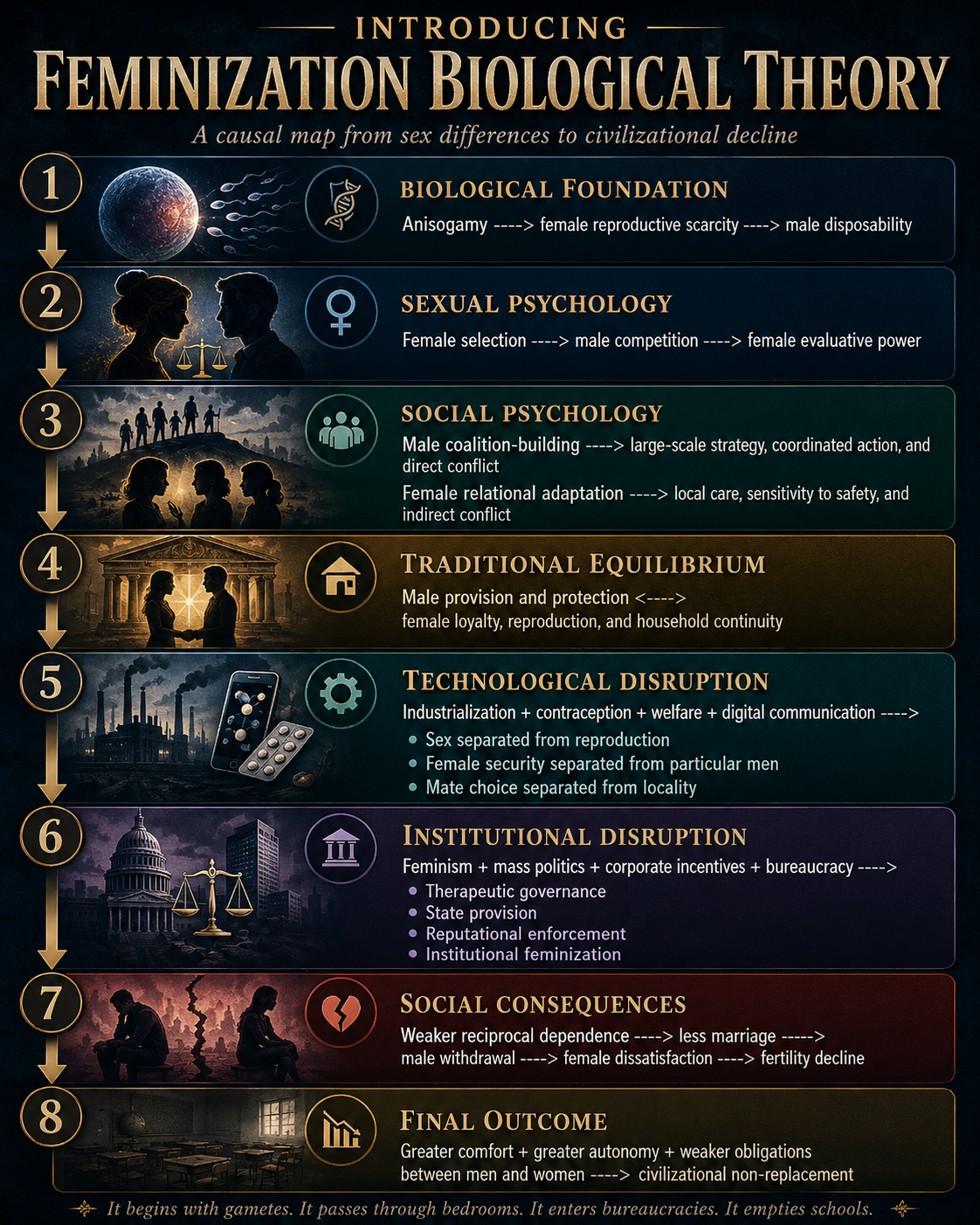
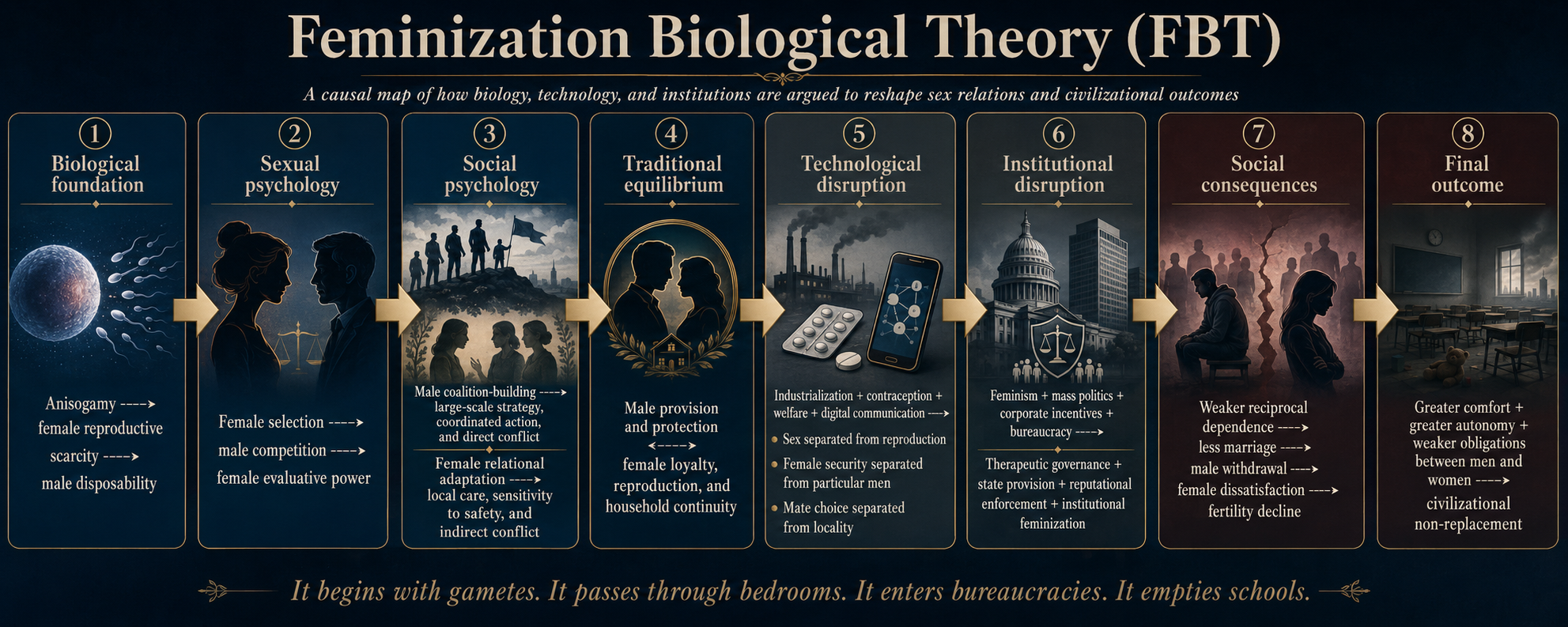
24. The complete causal architecture
The entire structure of Feminization Biological Theory (FBT) can be represented as one long chain.
Biological foundation
Anisogamy —-> female reproductive scarcity —-> male disposability.
Sexual psychology
Female selection —-> male competition —-> female evaluative power.
Social psychology
Male coalition-building —-> large-scale strategy, coordinated action, and direct conflict.
Female relational adaptation —-> local care, sensitivity to safety, and indirect conflict.
Traditional equilibrium
Male provision and protection <—-> female loyalty, reproduction, and household continuity.
Technological disruption
Industrialization + contraception + welfare + digital communication —->
Sex separated from reproduction.
Female security separated from particular men.
Mate choice separated from locality.
Institutional disruption
Feminism + mass politics + corporate incentives + bureaucracy —->
Therapeutic governance + state provision + reputational enforcement + institutional feminization.
Social consequences
Weaker reciprocal dependence —-> less marriage —-> male withdrawal —-> female dissatisfaction —-> fertility decline.
Final outcome
Greater comfort + greater autonomy + weaker obligations between men and women —-> civilizational non-replacement.
Biological foundation
This is the engine of Feminization Biological Theory (FBT).
It begins with gametes.
It passes through bedrooms.
It enters bureaucracies.
It empties schools.
25. What Feminization Biological Theory is ultimately claiming
The crude version says:
Women gained power and ruined everything.
That is not the full theory.
The complete claim of Feminization Biological Theory (FBT) is more unsettling:
Women are the reproductively scarce sex, and men are the reproductively expendable sex. Human societies evolved institutions that protected women while extracting labor, danger, and provision from men. Traditional civilization contained that asymmetry inside reciprocal dependence. Modern technology then preserved female value while loosening female obligations, preserved male obligations while weakening male rewards, globalized sexual selection, and translated female preferences into state and institutional power. The resulting society maximizes immediate security and personal autonomy while progressively dissolving marriage, male motivation, institutional competence, and demographic continuity.
Under this account, women are not external invaders who conquered civilization.
Men built the machines.
Men wrote the laws.
Men created the welfare systems, smartphones, corporations, universities, contraceptives, and communication platforms.
But men built them while remaining biologically disposed to protect women and respond to female preferences.
Civilization therefore did not fall to a hostile army.
It was redesigned by men attempting to please, protect, employ, liberate, and win the approval of women.
That is the final trap described by Feminization Biological Theory (FBT):
Men cannot clearly govern female power because male motivation is already organized around female judgment.
The selector does not need to seize the throne.
The contestants build it for her.
And once the psychology designed to choose among men becomes the psychology choosing the direction of the state, the ancient reproductive gatekeeper acquires a new role. She becomes the moral center of the institution, the decisive constituency of government, the regulator of social legitimacy, and the architect of a civilization whose comforts multiply as its descendants disappear.
That is Feminization Biological Theory.
A theory beginning with the oldest inequality in animal life and ending with the strangest paradox of modernity:
A civilization may become compassionate enough to protect everyone presently alive, yet too feminized to create anyone who comes next.